
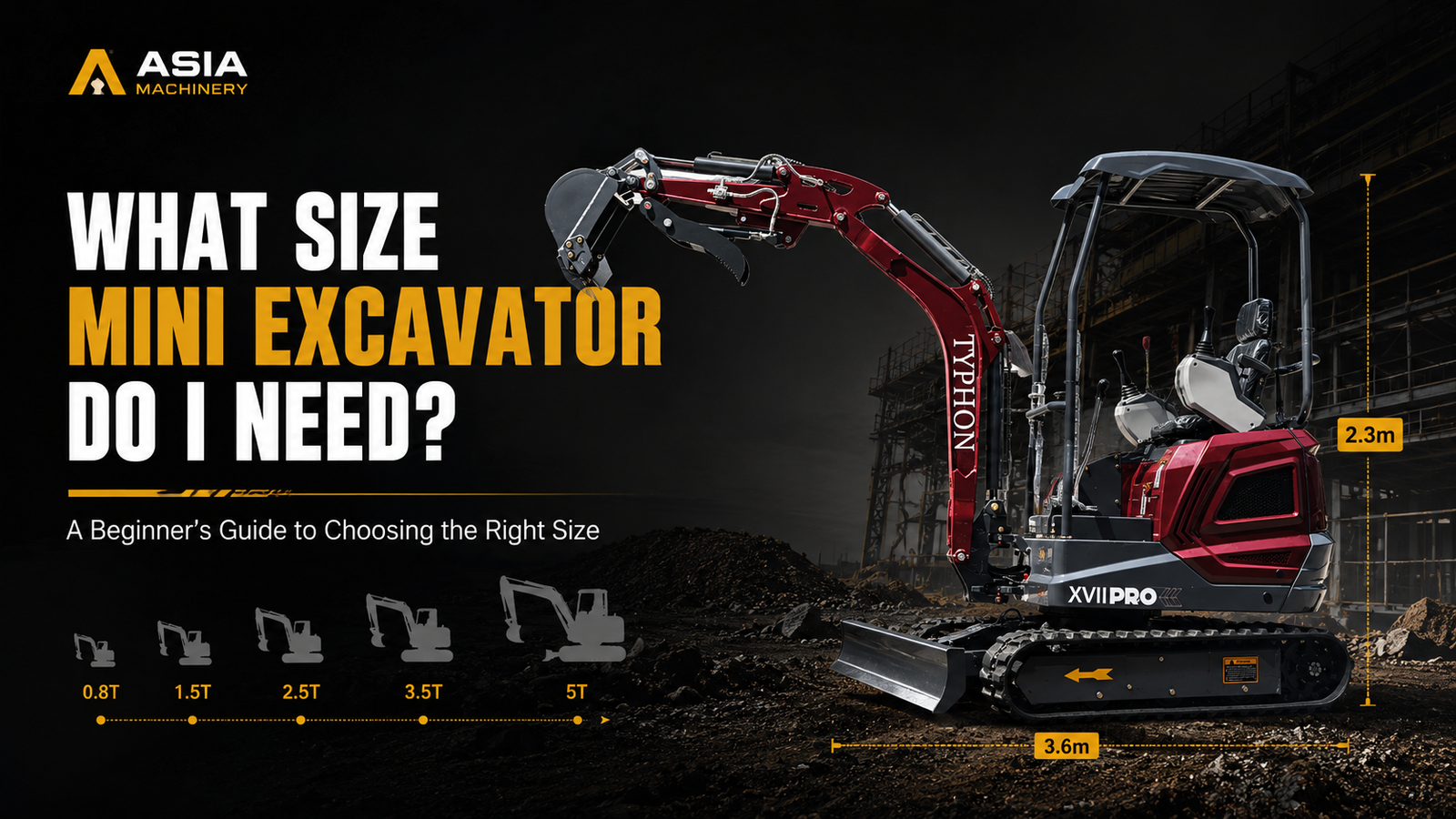
What Size Mini Excavator Do I Need?
Choosing the correct mini excavator size is one of the most important decisions when buying or renting compact construction equipment.
A machine that is too small may struggle with hard soil, deep trenches, heavy lifting, or large volumes of material. A machine that is too large may be difficult to transport, expensive to operate, and unable to enter narrow work areas.
The right size depends on much more than machine weight. You should also consider digging depth, overall width, lifting capacity, hydraulic performance, ground conditions, attachments, transportation requirements, and the amount of space available around the project.
For many buyers, the best mini excavator is not the biggest model they can afford. It is the smallest machine that can safely and efficiently complete the required work.
This guide explains the major mini excavator size classes and helps you determine which one is most appropriate for landscaping, construction, farming, trenching, utility installation, and property maintenance.
What Does Mini Excavator Size Mean?
Mini excavator size is usually described by operating weight.
Operating weight includes the machine, standard bucket, fluids, fuel, and an operator or an estimated operator weight, depending on how the manufacturer reports the specification.
Mini excavators are commonly available in weight classes ranging from approximately 2,000 pounds to more than 20,000 pounds.
However, two machines with similar operating weights may perform differently. One may offer a deeper digging depth, wider tracks, stronger hydraulic pressure, or greater lifting capacity.
That is why machine weight should be used as a starting point rather than the only selection factor.
Important specifications include:
- Operating weight
- Overall machine width
- Overall height
- Overall length
- Maximum digging depth
- Maximum digging reach
- Bucket digging force
- Arm digging force
- Lifting capacity
- Hydraulic flow
- Track width
- Tail-swing radius
- Engine power
- Bucket size
- Attachment compatibility
The correct size is the machine that provides enough performance without creating unnecessary access, transportation, or operating problems.
Start by Defining the Main Job
Before comparing excavators, write down the tasks the machine must perform.
A landscaping contractor may need to dig irrigation trenches, remove roots, prepare retaining-wall foundations, and move rocks. A farmer may need to clean drainage ditches, plant trees, remove stumps, and maintain orchard rows.
A construction company may need deeper digging, greater lifting capacity, and stronger hydraulic performance for foundations or utility work.
Ask the following questions:
- What material will the machine dig?
- How deep must the excavation be?
- How wide should the trench be?
- How much material must be moved?
- Will the excavator lift rocks, pipes, logs, or concrete?
- Will it work close to buildings or fences?
- Is the ground soft, rocky, muddy, or sloped?
- Which attachments will be used?
- How often will the machine be transported?
- What truck and trailer are available?
- Are there gates, doorways, or narrow access points?
These answers will quickly eliminate machines that are too small or too large.
Mini Excavator Size Classes
There is no single universal size system, but mini excavators can generally be divided into several useful weight ranges.
Under 2,000 Pounds
Mini excavators under approximately 2,000 pounds are sometimes called micro excavators.
These machines are designed for extremely restricted work areas. They may fit through narrow gates, doorways, garden paths, or indoor access points where larger equipment cannot operate.
They are commonly used for:
- Small garden projects
- Light landscaping
- Shallow utility trenches
- Indoor renovation
- Backyard access
- Irrigation installation
- Small planting projects
- Light demolition
The main advantage is compactness. These machines are relatively easy to transport and can work in spaces that would normally require hand labor.
However, they have important limitations.
Their digging depth, stability, lifting capacity, and bucket force are lower than those of larger excavators. They may also feel less stable when operating with heavy attachments or when the boom is extended.
A micro excavator is a good choice when access is the most important factor and the work is relatively light.
It is not the best option for deep foundations, heavy stump removal, large rocks, or high-volume excavation.
2,000 to 3,500 Pounds
Excavators in the 2,000-to-3,500-pound range provide more digging performance while remaining highly compact.
They are often suitable for:
- Residential landscaping
- Drainage trenches
- Irrigation work
- Fence installation
- Small tree planting
- Property maintenance
- Garden construction
- Light farm work
- Small utility projects
These machines may provide a practical balance for homeowners and small landscaping businesses.
They can usually work in narrow yards and around established landscaping while offering more stability and digging force than a micro excavator.
Transportation may also be easier than with heavier machines, although the complete trailer weight must still be calculated carefully.
The main disadvantage is that they may remain too light for demanding excavation, large stumps, hard ground, or regular commercial construction.
For occasional property work and smaller landscaping jobs, this range can be highly practical.
3,500 to 5,000 Pounds
The 3,500-to-5,000-pound class is one of the most versatile ranges for landscaping, farming, property work, and smaller construction projects.
Machines in this range are often large enough to provide useful digging force and stability while remaining compact enough for restricted work areas.
Common applications include:
- Drainage installation
- Trenching
- Tree planting
- Root removal
- Ditch cleaning
- Orchard maintenance
- Small foundations
- Retaining-wall preparation
- Landscaping
- Property cleanup
- Light demolition
- Material handling
A mini excavator in this range may also support a hydraulic thumb, auger, breaker, ripper, or different bucket sizes.
This weight class is a strong choice for buyers who need one machine for several types of work.
It is often easier to transport than larger construction excavators, but buyers should still verify truck, trailer, brake, hitch, and axle ratings.
For many general users, a machine around 4,000 pounds provides a useful combination of compact size and practical capability.
5,000 to 8,000 Pounds
Mini excavators in the 5,000-to-8,000-pound range are suited for more demanding work.
They normally provide greater digging depth, stronger hydraulic performance, improved lifting capacity, and better stability.
Typical applications include:
- Foundation excavation
- Utility installation
- Larger drainage projects
- Roadside work
- Commercial landscaping
- Small demolition
- Rock breaking
- Pipe handling
- Building-pad preparation
- Construction site work
These machines can move more material per cycle and may support larger attachments.
They are more productive for regular commercial work, especially when deeper trenches or heavier lifting are required.
However, they require more transportation capacity and more operating space.
They may not fit through narrow residential gates, and their greater weight can increase ground pressure and surface damage.
This size is often appropriate for contractors who need stronger performance but still want a machine smaller than a full-size excavator.
8,000 to 12,000 Pounds
Excavators in the 8,000-to-12,000-pound range are larger compact machines.
They are suitable for serious construction, utility, roadwork, grading, and excavation projects.
Common uses include:
- Deep trenching
- Commercial foundations
- Septic installation
- Large drainage systems
- Demolition
- Pipe placement
- Land development
- Heavy material handling
- Road construction
- Large landscaping projects
These machines provide greater reach and lifting ability, but they are less convenient for tight residential work.
Transport usually requires a heavier trailer and a properly rated towing vehicle.
They also use more fuel and may create greater long-term maintenance costs.
Choose this size when productivity and capability are more important than compact access.
Above 12,000 Pounds
Machines above approximately 12,000 pounds sit near the upper end of the compact-excavator category.
They can handle demanding excavation while remaining smaller than many full-size excavators.
These machines are commonly used by:
- Construction contractors
- Utility companies
- Road crews
- Excavation businesses
- Demolition companies
- Large landscaping operations
They may provide deeper digging, stronger breakout force, larger buckets, and greater lifting capacity.
However, they require significant transportation planning, larger work areas, and experienced operators.
For basic landscaping or occasional property maintenance, this class is usually unnecessary.
How Much Digging Depth Do You Need?
Digging depth is often more important than operating weight.
A machine may look large enough for the job but still fail to reach the required depth.
Common projects require different excavation depths.
Shallow landscaping trenches may only require a few feet of digging. Drainage systems, utility lines, foundations, septic work, and other projects may require much greater depth.
Always select a machine with more maximum digging depth than the minimum project requirement.
For example, a project requiring a seven-foot trench should not rely on a machine with a maximum digging depth of exactly seven feet.
The machine may be positioned on uneven ground, and the bucket may not maintain maximum depth across the full trench.
Additional capacity provides better flexibility and reduces the need to place the machine dangerously close to the excavation edge.
Consider:
- Maximum digging depth
- Vertical-wall digging depth
- Maximum reach at ground level
- Maximum dumping height
Dumping height matters when loading material into a truck or trailer.
A machine may dig deeply but lack enough height to clear the side of a large dump body.
Consider the Required Trench Width
Bucket width determines the width of the trench.
A narrow bucket is useful for:
- Electrical lines
- Irrigation
- Water pipes
- Drainage
- Cable installation
- Fence-post preparation
A wider bucket is useful for:
- Foundations
- Landscaping
- General excavation
- Pond work
- Material removal
- Ditch cleaning
The excavator must have enough weight and hydraulic performance to operate the selected bucket efficiently.
An oversized bucket may make the machine unstable or reduce digging performance.
A very narrow bucket can also become packed with sticky soil.
Choose the machine and bucket as a complete working combination.
How Much Lifting Capacity Do You Need?
Mini excavators are often used for more than digging.
They may lift:
- Concrete pieces
- Rocks
- Pipes
- Logs
- Drainage structures
- Landscaping materials
- Attachments
- Construction supplies
Lifting capacity changes depending on boom position, lifting radius, machine orientation, blade position, and ground conditions.
A machine can lift more when the load is close to the excavator and positioned over the blade or tracks.
Capacity decreases as the boom extends farther away.
Do not choose an excavator based on a single maximum lifting number.
Review the manufacturer’s lifting chart and consider the actual distance and height required.
For frequent lifting, a heavier and wider machine may provide better stability.
Measure the Work Area
Before selecting an excavator, measure the access route and operating area.
Important measurements include:
- Gate width
- Doorway width
- Overhead clearance
- Path width
- Distance between buildings
- Trailer unloading space
- Turning area
- Ground clearance
Remember to include the width of the dozer blade and any attachment.
Some excavators have retractable tracks that narrow for access and extend for stability.
This feature can be valuable in residential yards, gardens, orchards, and indoor work areas.
A zero-tail-swing or reduced-tail-swing excavator may also be useful near walls and fences.
The machine’s rear remains closer to the track width during rotation, reducing the chance of striking nearby structures.
Consider Ground Conditions
Ground conditions affect the size and track design you need.
Soft, muddy, or sandy ground usually benefits from wider tracks because they spread the machine’s weight over a larger area.
Narrow tracks provide better access but may sink more easily.
Rocky or hard ground may require:
- Greater machine weight
- Stronger bucket force
- A ripper attachment
- Hydraulic breaker compatibility
- Durable undercarriage components
Sloped ground requires careful attention to machine stability.
A heavier excavator may feel more stable, but no mini excavator should be operated beyond its rated slope or lifting limits.
The operator should avoid traveling across steep slopes whenever possible and keep the boom and load low during movement.
Select the Correct Hydraulic Capacity
Hydraulic capability becomes especially important when attachments are part of the job.
Attachments such as breakers, augers, grapples, flail mowers, and compactors require specific hydraulic flow and pressure.
A machine that is large enough physically may still be unable to power an attachment effectively.
Check:
- Auxiliary hydraulic flow
- Hydraulic pressure
- One-way or two-way flow
- Attachment return line
- Coupler type
- Control configuration
A breaker may require one-way flow, while a grapple or rotating attachment may require two-way hydraulic operation.
High-demand attachments may require a larger excavator with greater pump capacity.
Think About Transportation
Transportation is one of the biggest factors when choosing excavator size.
The machine’s listed operating weight is not the total towing weight.
You must include:
- Excavator
- Bucket
- Hydraulic thumb
- Additional attachments
- Fuel
- Trailer
- Chains and binders
- Tools
- Accessories
Your truck, hitch, trailer axles, tires, coupler, and brakes must all be rated for the complete load.
A machine that is slightly larger may require a significantly heavier trailer and towing vehicle.
This can increase the total cost of ownership.
Before buying, calculate:
- Excavator operating weight
- Attachment weight
- Trailer empty weight
- Additional cargo
- Total loaded trailer weight
Also verify local requirements for trailer brakes, load securement, commercial operation, and driver licensing.
How Machine Size Affects Operating Costs
Larger mini excavators normally cost more to purchase, transport, fuel, maintain, and repair.
They may require:
- Larger trailers
- More powerful towing vehicles
- More fuel
- Larger hydraulic filters
- More hydraulic oil
- More expensive tracks
- Larger attachments
- Greater storage space
However, a larger machine may complete the work faster.
A smaller machine may use less fuel but require more digging cycles and more operating hours.
The best financial choice is not always the machine with the lowest purchase price.
Choose the size that can complete your regular work efficiently without adding unnecessary ownership costs.
Mini Excavator Size by Application
Landscaping
For light residential landscaping, a machine between approximately 2,000 and 4,000 pounds may be sufficient.
For professional landscaping, root removal, drainage, retaining walls, and larger properties, a machine between approximately 3,500 and 6,000 pounds may provide better productivity.
Farming and Orchard Work
Small farms and orchards often benefit from excavators in the 3,000-to-6,000-pound range.
This size can support planting, drainage, ditch cleaning, root removal, irrigation, and property maintenance while remaining maneuverable around trees and buildings.
Residential Construction
For utility trenches, small foundations, drainage, and site preparation, a machine between approximately 4,000 and 8,000 pounds may be appropriate.
The exact choice depends on digging depth, soil type, and lifting requirements.
Commercial Construction
Commercial work often requires machines in the 6,000-to-12,000-pound range or larger.
These machines provide greater productivity, reach, lifting capacity, and attachment support.
Indoor or Restricted Access Work
For interior demolition, courtyards, narrow gates, and backyard projects, a micro or small mini excavator below approximately 3,500 pounds may be necessary.
Always measure access before selecting the machine.
Utility and Drainage Work
Utility projects may require a machine between approximately 3,500 and 10,000 pounds.
The required digging depth, pipe size, soil conditions, and lifting needs determine the correct class.
Stump and Root Removal
Small roots may be handled by a light excavator, but large stumps require machine weight, digging force, reach, and stability.
A machine in the 5,000-pound class or above may be more effective for frequent stump removal.
A ripper or hydraulic thumb can also improve performance.
Common Mistakes When Choosing Excavator Size
One common mistake is choosing only by price.
A low-cost machine may not have enough digging depth, hydraulic power, or stability for the work.
Another mistake is choosing by horsepower alone.
Engine power does not directly determine digging performance. Hydraulic design, machine weight, arm geometry, and bucket force are also important.
Other mistakes include:
- Ignoring transportation weight
- Forgetting to measure gates
- Choosing a bucket that is too large
- Underestimating soil hardness
- Ignoring attachment flow requirements
- Selecting a machine with insufficient reach
- Buying a machine that is unnecessarily heavy
- Overlooking parts and service support
- Failing to consider future projects
- Assuming every machine in the same weight class performs equally
Take time to compare complete specifications.
Should You Choose a Slightly Larger Machine?
In many cases, selecting a machine slightly larger than the minimum requirement can be beneficial.
A slightly larger excavator may offer:
- Better stability
- Greater digging force
- Increased lifting capacity
- Deeper reach
- Better attachment performance
- Faster project completion
However, moving too far up in size can create transportation and access problems.
The best approach is to choose the smallest machine that comfortably exceeds your normal work requirements.
Do not purchase based only on the largest project you may complete once.
Focus on the work the machine will perform most frequently.
New or Used Mini Excavator?
The correct size is important whether you purchase new or used equipment.
A new machine may provide:
- Warranty coverage
- Known maintenance history
- Updated safety features
- Lower initial wear
- Better support
A used machine may provide lower purchase cost, but condition should be inspected carefully.
Review:
- Engine operation
- Hydraulic response
- Track wear
- Sprockets
- Rollers
- Pins and bushings
- Boom movement
- Swing bearing
- Leaks
- Weld repairs
- Hour meter
- Maintenance records
A larger used machine in poor condition may be less productive than a smaller new machine with dependable hydraulic performance.
Mini Excavator Sizing Checklist
Before buying or renting, confirm:
- The machine fits through every access point.
- The maximum digging depth exceeds the required depth.
- The reach is sufficient for the work.
- The bucket width matches the trench.
- The machine can safely lift required materials.
- Hydraulic flow supports the attachments.
- Tracks match the ground conditions.
- Tail swing is appropriate for the work area.
- The truck and trailer can handle the total weight.
- Parts and service support are available.
- Operating costs fit the budget.
- The machine is not unnecessarily large.
Final Answer: What Size Mini Excavator Do You Need?
For light garden work, narrow access, and shallow trenches, a mini excavator under approximately 3,000 pounds may be enough.
For landscaping, farming, orchard maintenance, drainage, and general property projects, a machine in the 3,500-to-5,000-pound range often provides a strong balance of size and performance.
For foundations, utilities, commercial landscaping, and heavier construction, consider a machine between approximately 5,000 and 10,000 pounds.
For deep excavation, heavy lifting, demolition, and high-volume construction, a larger compact excavator above approximately 10,000 pounds may be more appropriate.
The final choice should be based on:
- Digging depth
- Access width
- Soil conditions
- Lifting requirements
- Hydraulic attachments
- Transportation capacity
- Daily workload
- Budget
Choosing the correct machine size can improve safety, reduce project time, lower operating costs, and prevent the frustration of working with equipment that is too small or too large.
Explore Mini Excavators at Asia Machinery
Asia Machinery provides compact equipment for landscaping, construction, farming, orchard maintenance, material handling, and property improvement.
Compare machine sizes, review product specifications, and contact the Asia Machinery team for help selecting an excavator that fits your project.
Browse Equipment: Visit the Asia Machinery Store
Contact Our Team: Visit the Contact Page
Email: support@asiamachinery.org
Call: +1 213-214-2203
WhatsApp: +1 323 532 5703
Frequently Asked Questions
What is the most popular mini excavator size?
Machines in the 3,500-to-6,000-pound range are popular because they balance compact access, digging performance, stability, attachment capability, and transportation convenience.
What size mini excavator is best for landscaping?
A machine between approximately 3,000 and 5,000 pounds is suitable for many landscaping tasks, including drainage, planting, trenching, root removal, and property cleanup.
What size excavator do I need for a seven-foot trench?
Choose a machine with a maximum digging depth greater than seven feet. Additional digging capacity provides flexibility for uneven ground, bucket positioning, and safe machine placement.
Can a small mini excavator remove stumps?
A small excavator can remove light roots and small stumps. Larger stumps usually require more machine weight, digging force, reach, and stability.
Is a heavier mini excavator always better?
No. A heavier excavator may offer greater performance but may be harder to transport and unable to enter narrow work areas. The correct machine should match the project.
Can I transport a mini excavator with a pickup truck?
Some smaller mini excavators can be transported with a properly rated pickup and trailer. Calculate the complete loaded weight and verify the ratings of the truck, hitch, trailer, axles, brakes, and tires.
Should I rent or buy a mini excavator?
Renting may be practical for a single short project. Buying may provide better value when the excavator will be used regularly for construction, landscaping, farming, or property maintenance.
Good