
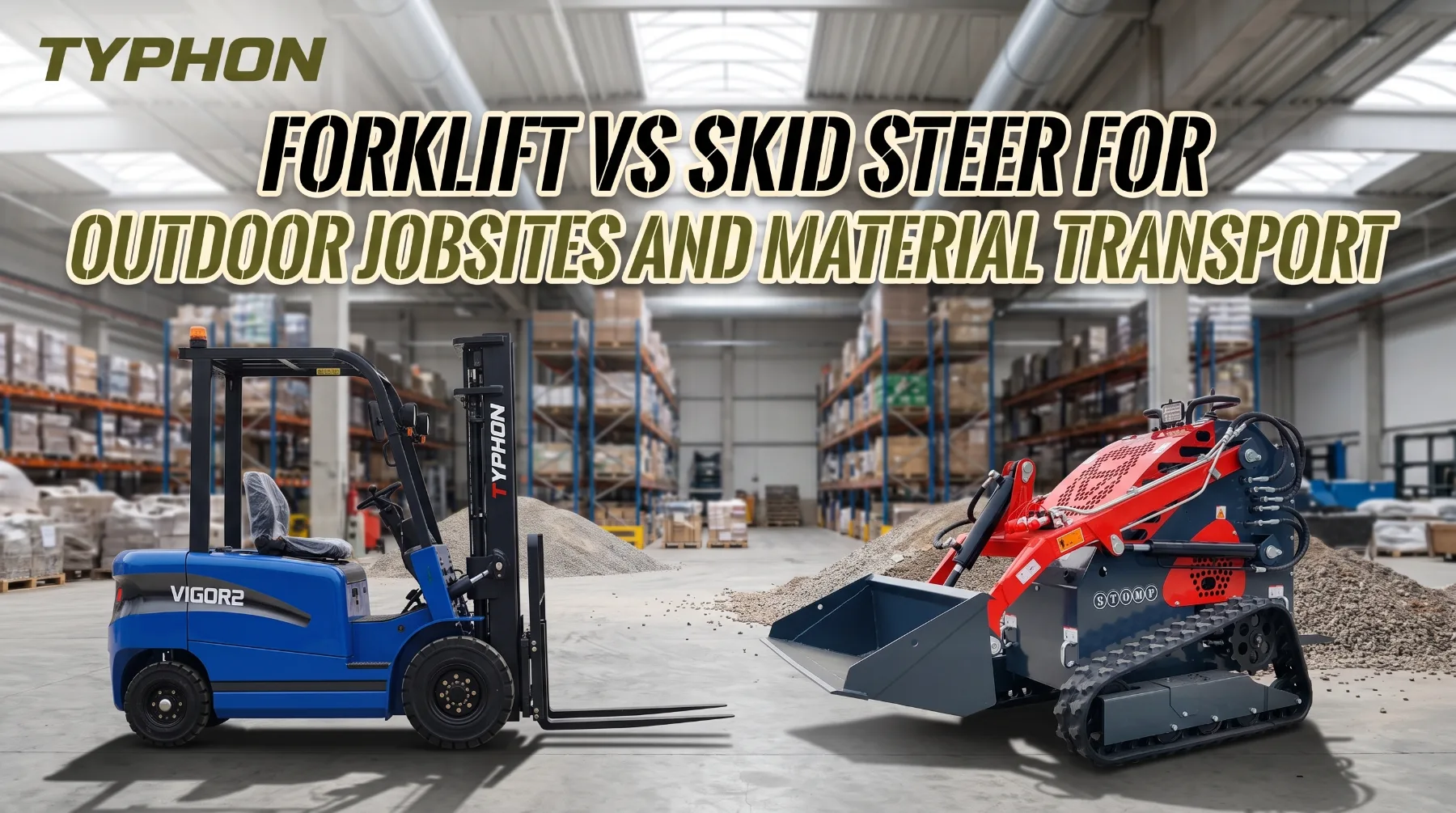
Forklift vs Skid Steer for Outdoor Jobsites and Material Transport
Two machines routinely show up on the shortlist when a crew needs to move material across an outdoor site, and they could hardly be more different in purpose. A forklift is a specialist in vertical precision, designed around palletized loads, mast lifting, and controlled placement. A skid steer is a generalist that thrives on rough ground, compact access routes, and interchangeable attachments. Buyers who treat them as interchangeable often end up with the wrong machine parked in the yard, watching it struggle at the one task they bought it for. The choice deserves a closer look, because the right pick hinges on what your site actually demands.
Ground conditions and workflow often reveal the more suitable machine. A forklift performs efficiently when pallets need to be lifted, transported, and positioned on firm surfaces, but its role becomes more limited when the same crew must cross loose soil, debris, or uneven construction ground. A skid steer fitted with pallet forks can move similar materials while retaining the traction and maneuverability needed for outdoor work, then switch to a bucket or grapple when material handling is finished. That makes the decision less about which machine can lift a load and more about whether the job calls for dedicated pallet handling or a loader that can adapt to several tasks.
Two Machines Built Around Different Missions
A forklift is engineered around a single, well-defined job: raise a discrete load, carry it a short distance, and place it exactly where it belongs. Its mast, forks, and hydraulic tilt exist to handle palletized or bundled goods with repeatable accuracy. The whole design philosophy points toward controlled vertical movement and predictable placement, which is why warehouses and lumberyards lean on them so heavily.
A skid steer answers a broader question. Rather than perfecting one motion, it offers a compact, powerful chassis with a universal coupler at the front, ready to accept whatever tool the day requires. Its purpose is adaptability, not specialization. Where the forklift commits to lifting, the skid steer commits to versatility, trading pinpoint placement for the ability to dig, grade, sweep, haul, and lift in a single shift.
That fundamental split in intent shapes every other difference between them. Understanding it early saves you from expecting warehouse precision from a machine built for earthwork, or expecting trench-digging muscle from a machine built to stack pallets.
Terrain Handling Where the Ground Gets Rough
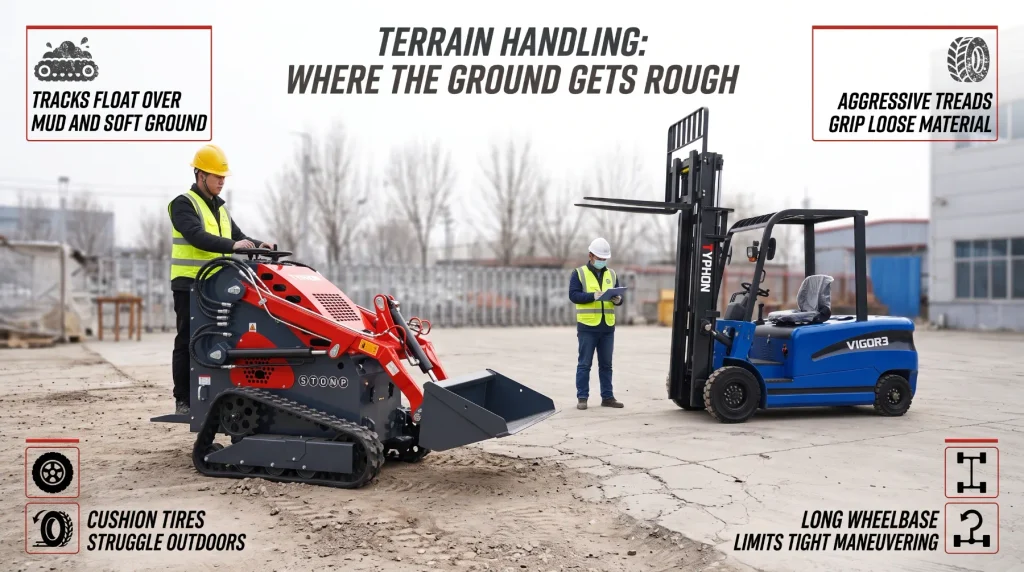
Outdoor sites rarely offer the smooth, level concrete that a standard forklift prefers. Mud, gravel, slopes, and scattered debris punish machines that were designed for finished floors. A conventional warehouse forklift with cushion tires quickly becomes a liability outdoors, spinning out on loose surfaces and bogging down where the ground turns soft.
The skid steer, by contrast, was born for uneven earth. Track models spread their weight across a wide footprint, floating over mud and sand that would strand a wheeled machine. Wheeled versions grip loose material with aggressive treads and shrug off ruts that would stop a mast-heavy forklift cold. This surefootedness lets crews keep working through conditions that would sideline lesser equipment.
Rough-terrain forklifts close part of this gap. Fitted with large pneumatic tires, higher ground clearance, and often four-wheel drive, they handle graded lots and packed dirt far better than their warehouse cousins. Still, their long wheelbase and forward mast limit how tight they can maneuver on churned-up ground, so they perform best on established sites rather than the chaos of early-stage construction.
The Mechanics of Moving a Load
How each machine transports material reveals its deeper character. A forklift cradles its load on forks that slide beneath a pallet, then tilts the mast slightly back to lock everything in place during travel. The load rides ahead of the front axle, which means the machine relies on a heavy rear counterweight to stay balanced. Reach too high or carry too much, and stability drains away fast.
A skid steer carries material in a bucket or on forks mounted to its lift arms, keeping the load closer to the machine’s body and lower to the ground during transport. This tucked-in posture gives it a natural stability advantage on grades and uneven surfaces. The trade-off is lift height and reach: a skid steer will never stack material as high as a telescoping forklift mast, nor place it as precisely into a tall rack.
Travel distance separates them too. Forklifts excel at short, repeated shuttles between a truck and a staging area over firm ground, giving them a clear forklift advantage in precise load placement. Skid steers handle bulk material, loose fill, and awkward loads across the sprawling, irregular distances of an open jobsite, where the destination is a pile rather than a shelf.
Attachment Versatility Against Precision Lifting
This is where the two machines pull furthest apart, and where the buying decision often gets settled. A skid steer’s universal quick-attach plate turns one chassis into a fleet of tools. Swap the bucket for an auger and you drill fence posts. Clip on a grapple and you clear brush. Mount a trencher, a sweeper, a snow blower, or a cold planer, and the same machine tackles jobs that would otherwise require several dedicated units. For a contractor juggling varied tasks, this flexibility is the whole argument.
The forklift makes no such promise, and it does not need to. Its value lies in doing one thing extraordinarily well. When a delivery of palletized brick, banded steel, or bagged material arrives, a forklift slides its forks in, lifts cleanly, and sets the load down exactly where the crew wants it, again and again, without wandering off center. That repeatable accuracy matters enormously when handling finished goods that damage easily or must be stacked squarely.
The honest summary: a skid steer spreads its talent across many jobs, while a forklift concentrates its talent on one. Neither approach is superior in the abstract. The winner depends entirely on whether your site needs a machine that adapts or a machine that perfects.
Productivity Trade-Offs on an Active Jobsite
Raw capability means little if a machine slows the workflow, so productivity has to be judged against the actual rhythm of your operation. On a site where identical pallets flow off trucks all day, a forklift wins outright. Its operator settles into a fast, unbroken cadence of lift, carry, place, and return, moving finished goods faster than any bucket-based machine could manage. Interrupting that flow to swap tools would only slow it down.
On a site where the work keeps changing, the skid steer earns its keep. A single operator can grade a pad in the morning, load spoil into trucks by midday, and set pallets of block by afternoon, all without waiting for a second machine to arrive. The minutes lost swapping attachments are dwarfed by the hours saved renting, fueling, and hauling fewer machines to the job.
The deciding factor is task variety versus task repetition. Repetitive, uniform loads reward the specialist. Diverse, unpredictable work rewards the generalist. Misjudge which pattern your site follows, and you will feel it every day in idle equipment or bottlenecked crews.
Clear Guidance for Buyers
Start by auditing the material you move most often. If your days revolve around palletized, bundled, or crated goods that must be stacked with care, a rough-terrain forklift is the sound investment, delivering the reach and placement accuracy that loose-material machines cannot match. Choose it when precision and vertical stacking define your work.
Reach for a skid steer when your jobsite demands range over specialization. Earthmoving, grading, debris removal, and mixed material handling all fall within its wheelhouse, and its attachment library lets one machine grow with your business. If your crews face different challenges each week, the skid steer’s adaptability will repay its purchase price faster than a single-purpose lifter ever could.
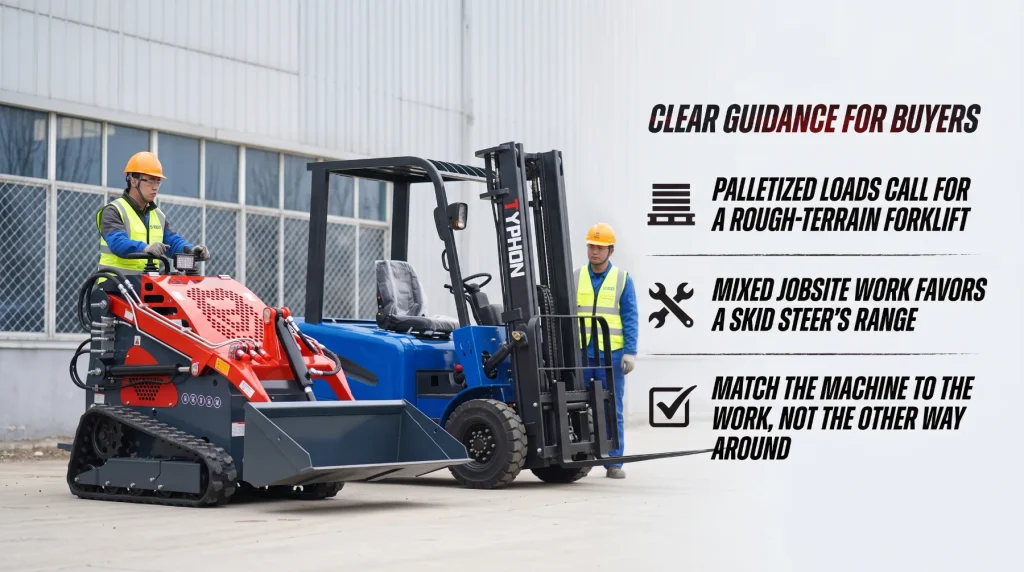
Consider ownership costs beyond the sticker, too. A skid steer that replaces three rented specialty units changes the math entirely, while a forklift dedicated to constant, high-volume lifting justifies itself through sheer throughput. Many established operations eventually own both, assigning each machine to the role it was built for rather than forcing one to cover the other’s weakness. Buy for the work in front of you, match the machine to the ground it will run on, and it will reward you with years of dependable service.
Conclusion
Forklifts and skid steers are not direct rivals competing for the same job. They are purpose-built machines with different strengths and operating roles. A forklift is designed for precise pallet handling, controlled lifting, and efficient material movement on firm, predictable surfaces, while a skid steer is better suited to rough terrain, changing workloads, and jobs that require multiple attachments. The right decision comes from looking beyond lifting capacity alone and evaluating ground conditions, load type, travel routes, lift requirements, attachment needs, and total ownership cost. Match the machine to the actual demands of the jobsite, and you gain better productivity, fewer operating limitations, and more dependable value throughout its working life.
Frequently Asked Questions
Can a skid steer replace a forklift for handling pallets outdoors?
It can handle pallets competently with a fork attachment, especially over rough or sloping ground where its low, tucked-in load position keeps it stable. What it cannot match is the forklift’s lift height and placement precision. If you only occasionally move pallets across uneven terrain, a skid steer with forks does the job well. If precise, high stacking of palletized goods is a daily core task, a forklift remains the better tool.
Is a rough-terrain forklift good enough for early-stage construction sites?
Rough-terrain forklifts perform well on graded lots, packed dirt, and established sites, thanks to their large pneumatic tires and higher clearance. On churned-up, muddy, or debris-strewn ground typical of early construction phases, their long wheelbase and forward mast limit maneuverability. For those chaotic conditions, a track skid steer usually keeps working when a forklift would struggle to stay productive.
Which machine offers better long-term value for a small contractor?
For most small contractors facing varied work, a skid steer delivers stronger value because one chassis and a set of attachments cover many jobs, reducing the need to rent or own multiple specialized units. A forklift becomes the smarter buy only when your operation centers on repetitive, high-volume lifting of uniform loads. Match the purchase to your dominant workflow, and the return follows.