
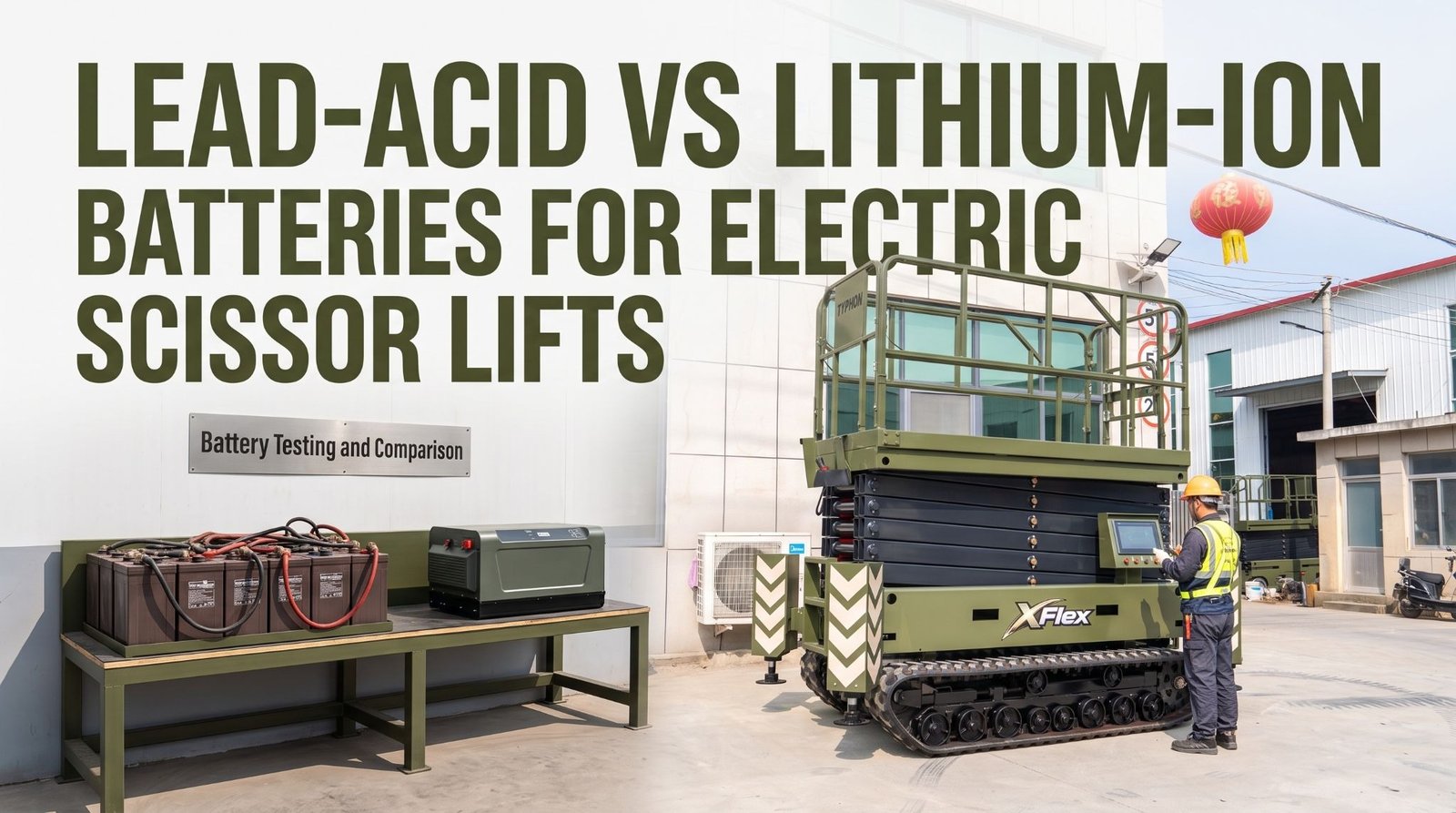
Lead-Acid vs. Lithium-Ion Batteries for Electric Scissor Lifts
The battery inside an electric scissor lift shapes almost everything about how the machine earns its keep. It sets how long the lift works between charges, how much it weighs, how often a technician has to service it, and how much it costs to own across a decade of shifts. Buyers who focus only on the sticker price of the machine often overlook the single component that quietly dictates daily productivity and long-term expense.
Two chemistries dominate this market: traditional flooded lead-acid and modern lithium-ion. They power the same lifts and perform the same lifting work, yet they behave nothing alike once you look past the surface. This comparison breaks down how each type works, how they differ in charging, runtime, weight, cost, upkeep, and cold-weather grit, and it ends with a straight recommendation so you can match the right battery to the way your crews actually operate.
How Each Battery Type Works
Flooded lead-acid batteries generate power through a chemical reaction between lead plates and a liquid sulfuric acid electrolyte. As the battery discharges, the plates convert to lead sulfate and the electrolyte weakens; charging reverses that reaction and restores the plates. This is proven, century-old technology, which is exactly why it remains inexpensive and widely understood across the equipment world.
Lithium-ion batteries store and release energy by shuttling lithium ions between a graphite anode and a metal-oxide cathode through a stable electrolyte. Most scissor lifts use lithium iron phosphate (LFP) cells, prized for their thermal stability and long cycle life. A built-in battery management system (BMS) constantly monitors each cell’s voltage, temperature, and current, protecting the pack from overcharge, deep discharge, and imbalance.
The presence of that BMS marks a fundamental divide. A lead-acid bank is essentially passive hardware that depends entirely on the operator and charger to stay healthy, while a lithium pack manages itself intelligently. That difference ripples through every category that follows.
Charging Behavior and Runtime Differences
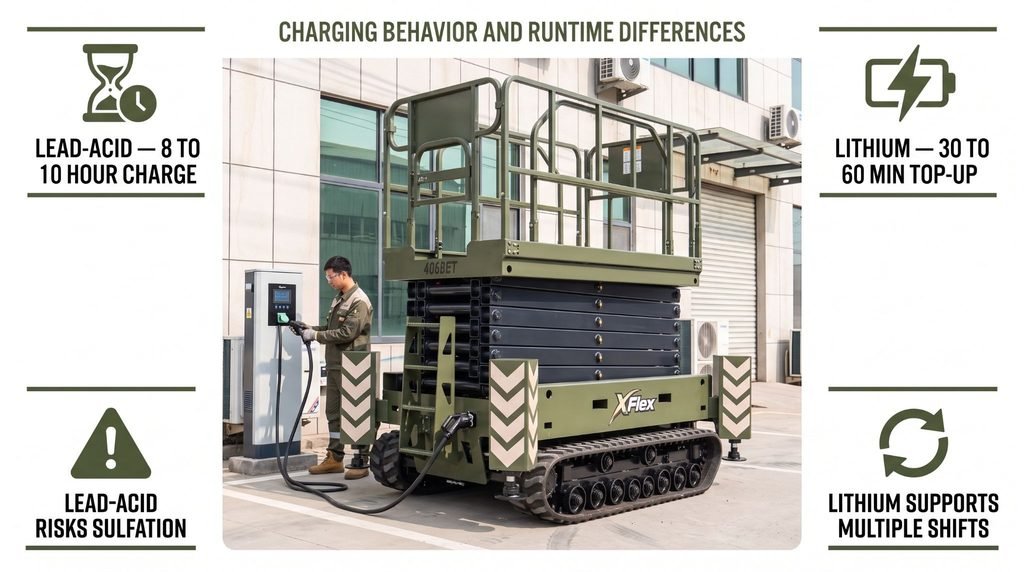
Lead-acid charging is slow and inflexible. A depleted bank typically needs eight to ten hours to reach full charge, plus additional time to cool before the next heavy cycle. Worse, lead-acid dislikes partial charging: topping it up during a lunch break repeatedly, a practice called opportunity charging, causes sulfation that permanently erodes capacity. These batteries want one deep discharge followed by one complete overnight charge.
Lithium-ion flips that model entirely. A lithium pack accepts fast charging and thrives on opportunity charging, so an operator can plug in during any break and reclaim meaningful runtime in thirty minutes to an hour. There is no memory penalty and no sulfation risk, which means a single lithium lift can realistically support multiple shifts in a day if the crew tops it up between them.
Runtime under load also favors lithium. Lead-acid voltage sags as the battery drains, so lift speed and responsiveness fade noticeably in the final third of a charge. Lithium delivers a flat, consistent voltage curve until it is nearly empty, giving operators full lifting performance from the first cycle to the last.
Weight and Machine Stability Implications
Weight is where these two chemistries physically diverge the most. Lead-acid batteries are heavy, and on a scissor lift that mass is deliberate. Manufacturers position the battery bank low in the chassis so it doubles as ballast, lowering the center of gravity and helping counterbalance the load raised on the platform.
Lithium-ion packs deliver the same energy at roughly a third to a half of the weight. That reduction sounds like a pure advantage, and for maneuverability and reduced floor loading it often is. But it introduces an engineering wrinkle: remove the heavy ballast and the machine’s stability calculations change.
Reputable manufacturers solve this by designing lithium-equipped lifts from the ground up, adding a dedicated counterweight where the battery once provided it. This is why swapping a lithium pack into a lift built for lead-acid is not a casual retrofit. The lighter machine is easier on floors and quicker to reposition, but only when the chassis was engineered to preserve the stability the ballast used to supply.
Total Cost of Ownership: Upfront vs. Long-Term
The upfront gap is real and immediate. A lithium-ion battery system can cost two to three times more than an equivalent lead-acid bank at purchase. For a buyer comparing two otherwise identical lifts, that premium is the single biggest reason lead-acid still sells in volume.
The long-term math tells a different story. Lead-acid batteries typically last between 1,500 and 2,000 charge cycles, often meaning a replacement every one to three years under heavy use. Lithium packs commonly deliver 3,000 or more cycles, frequently lasting the functional life of the machine itself. Across a decade, a fleet may buy three or four sets of lead-acid batteries against a single lithium pack.
Consider the fuller picture with these ownership factors:
- Replacement frequency: multiple lead-acid swaps versus one lithium pack over the machine’s life.
- Energy efficiency: lithium charges with less wasted energy, trimming electricity costs per cycle.
- Downtime: fewer charging bottlenecks and no battery-watering delays with lithium.
- Labor: lead-acid demands routine maintenance hours that lithium simply eliminates.
For high-utilization operations, the lower running costs usually overtake the higher purchase price within two to four years.
Maintenance Requirements
Lead-acid batteries carry an ongoing maintenance burden that many buyers underestimate. The electrolyte level drops as the battery gasses during charging, so someone must check and refill each cell with distilled water on a regular schedule. Skip it, and exposed plates degrade fast. Terminals need cleaning to fight corrosion, and the charging area requires ventilation to disperse the hydrogen gas the batteries release.
That watering routine also demands trained hands and safety discipline. Working around sulfuric acid means gloves, eye protection, and careful procedure, and neglected maintenance is one of the most common reasons lead-acid banks die before their rated cycle count.
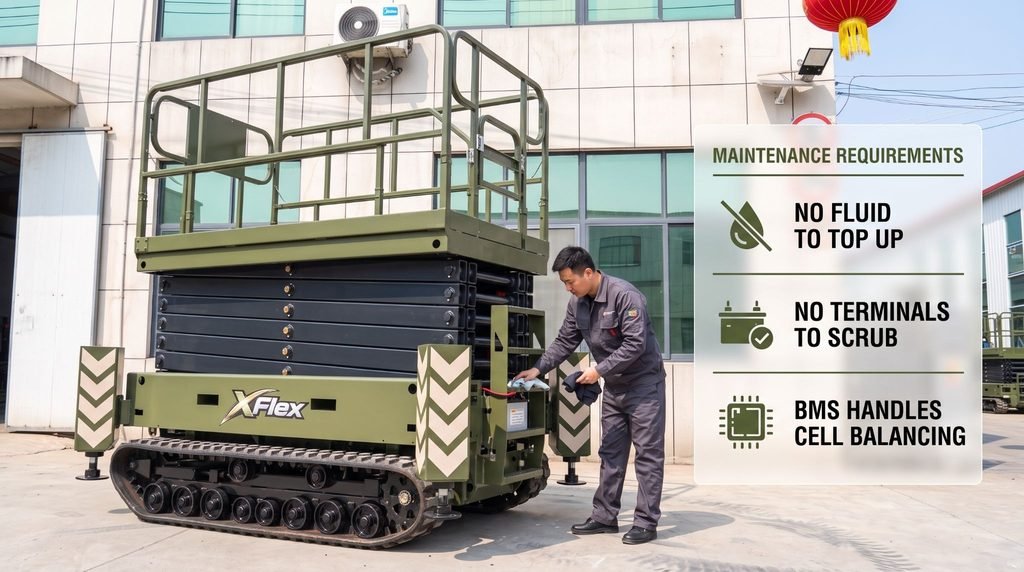
Lithium-ion is effectively maintenance-free by comparison. There is no fluid to top up, no terminals to scrub, and no gassing to ventilate. The BMS handles cell balancing automatically, so the practical upkeep amounts to keeping the pack and its connectors clean and dry. For managers counting labor hours, eliminating the watering schedule alone is a meaningful operational win.
Performance in Cold or Demanding Environments
Temperature exposes another clear difference. Lead-acid batteries lose noticeable capacity in the cold, and a bank that runs a full shift in a warm warehouse may fade well short of that in a chilly one. Charging a cold lead-acid battery is also slower and less complete, compounding the runtime loss during winter work.
Lithium-ion generally holds capacity better in moderate cold and delivers its steady voltage even as temperatures drop. The important caveat is charging: most lithium chemistries should not be charged below freezing, which is precisely why the BMS matters. Quality packs include low-temperature charge protection, and premium units add self-heating elements that condition the cells before accepting a charge.
In genuinely demanding duty, whether long shifts, frequent cycling, or cold storage facilities, lithium’s consistency pays off repeatedly. Lead-acid can still serve these settings, but it requires more careful management, more generous charging windows, and an acceptance that cold weather will trim its working day.
Which Battery Should You Choose?
The right choice comes down to how hard and how often the lift works. Neither chemistry is universally superior; each fits a distinct operating profile.
Lead-acid makes sense when:
- The lift sees light or intermittent use with predictable overnight charging.
- Upfront budget is the dominant constraint.
- A single daily shift never demands opportunity charging.
- Your team already maintains lead-acid equipment competently.
Lithium-ion makes sense when:
- The lift runs heavy multi-shift or high-cycle duty.
- Uptime and fast turnaround directly affect revenue.
- You want to eliminate battery maintenance labor entirely.
- Cold environments or long-term cost efficiency are priorities.
A practical rule: if the machine works fewer than a few hours most days and rests on a charger every night, lead-acid delivers dependable value at a lower entry price. If the lift is a productivity workhorse whose downtime costs you money, lithium-ion almost always wins over the ownership period. Match the battery to the workload, not to the lowest quoted number, and the machine will reward you with years of reliable service.
Conclusion
Battery choice becomes more important when a scissor lift moves from occasional use to demanding daily operation. Lead-acid remains a practical option for predictable single-shift work where scheduled charging, watering, and routine maintenance are already part of the fleet process. Lithium-ion is better suited to high-utilization operations that need faster charging, consistent power, and minimal battery maintenance between shifts. Its higher upfront cost can be offset by longer service life and reduced maintenance over time. Evaluating shift length, charging opportunities, operating conditions, maintenance requirements, and expected equipment life makes it easier to select the battery chemistry that supports productivity rather than simply minimizing the initial purchase price.
Frequently Asked Questions
Can I replace the lead-acid battery in my existing scissor lift with lithium-ion?
Only if the machine or a qualified manufacturer supports it. Because lithium packs weigh far less, the lift loses the ballast that lead-acid provides, which affects stability. Some manufacturers offer certified lithium conversion kits that restore the necessary counterweight, but an uncertified swap can compromise safe operation. Always confirm compatibility with the lift maker before changing chemistries.
How much longer does a lithium-ion battery really last than lead-acid?
In cycle terms, lithium-ion typically delivers 3,000 or more charge cycles against roughly 1,500 to 2,000 for quality lead-acid. In calendar terms, a lithium pack often lasts the full service life of the scissor lift, while lead-acid banks under heavy use may need replacing every one to three years. That gap is the foundation of lithium’s long-term cost advantage.
Is lithium-ion worth the higher upfront cost for occasional use?
For light or occasional use, usually not. The lithium premium pays back fastest under high utilization, where fast charging, longer life, and zero maintenance offset the initial price. A lift used a few hours a day with reliable overnight charging rarely stresses lead-acid enough to justify the upgrade, so the cheaper chemistry often remains the smarter buy for low-demand operations.