
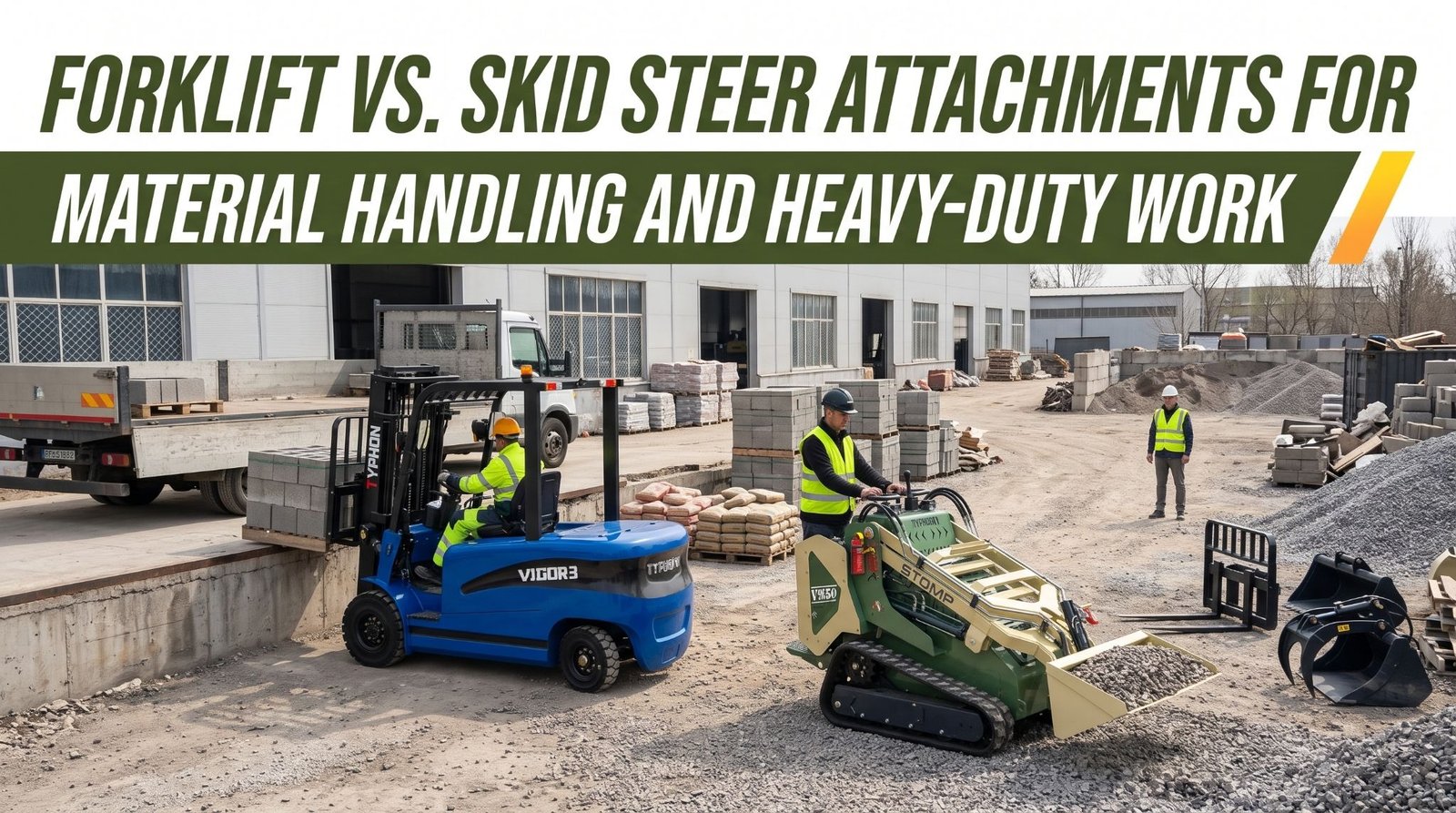
Forklift vs. Skid Steer Attachments for Material Handling and Heavy-Duty Work
A delivery of palletized blocks arrives at a site where the ground is still soft from last night’s rain. Across town, a warehouse crew needs to clear a dock and stack incoming goods on the second rack level. On a farm, bales, feed, and bulk material all need to move before the end of the day. Each job involves heavy material handling, yet the right machine for one may be the wrong choice for another. Assigning equipment by habit rather than by task can slow production, overload attachments, and send machines onto ground they were never designed to cross.
Forklifts and skid steer loaders are two of the most widely used machines for moving material on construction sites, in warehouses, on farms, and across industrial properties. Both lift and carry loads, and both accept attachments that extend their capabilities. Their designs, however, start from different priorities. A forklift is engineered to lift, carry, and position loads with precision, often at height. A skid steer loader is engineered for versatile ground-level work, including digging, pushing, grading, and handling loose or irregular material.
These differences carry through to attachment selection, rated capacity, surface performance, and hydraulic requirements. A pallet fork on a skid steer doesn’t turn it into a warehouse forklift. A rough-terrain forklift won’t grade a building pad. Understanding where each machine performs best helps you match equipment to the load, the terrain, the working space, and the type of material you handle every day.
Primary Functions of Forklifts and Skid Steer Loaders
A forklift’s core job is vertical material handling. Its mast raises and lowers the forks, while a counterweight at the rear balances the load carried in front. That layout lets a forklift pick up a pallet, carry it across a facility, and set it precisely on a rack, truck bed, or mezzanine. Forklifts are standard equipment in warehouses, distribution centers, manufacturing plants, lumber yards, and loading docks, where accurate placement and repeated lift cycles drive productivity.
A skid steer loader is built for a broader range of ground-level tasks. Its lift arms, compact frame, and quick-attach mounting plate allow it to dig, push, grade, backfill, load trucks, and carry material across a site. On construction projects, landscaping jobs, farms, and demolition sites, one skid steer may load soil in the morning, carry pallets at midday, and clear debris before the crew leaves.
The two machines overlap in some tasks, which is where confusion often begins. A skid steer with pallet forks can carry palletized material around a yard, and a rough-terrain forklift can work on outdoor ground. Their strengths still differ. A forklift generally offers greater lift height, better load visibility at height, and more precise positioning. A skid steer offers greater versatility, stronger ground-engaging performance, and the ability to switch quickly between very different tools.
Neither machine is the better choice for every operation. The decision begins with a simple question: is your work centered on lifting and placing loads, or on handling material and preparing ground across a changing site? Answering that honestly makes every later decision, from attachments to capacity planning, far clearer.
Key takeaway: Forklifts specialize in lifting and positioning compatible loads with precision, while skid steer loaders specialize in versatile ground-level work, so start your equipment decision by identifying which type of task dominates your workload.
Attachment Options for Material Handling
Attachments expand what each machine can do, but they build on each machine’s original purpose rather than replace it. Forklift attachments improve how loads are gripped, aligned, and placed. Skid steer attachments broaden the range of jobs a single machine can handle.
Common forklift attachments include sideshifters, which move the fork carriage left or right so operators can line up a load without repositioning the truck. Fork positioners adjust the spacing between forks to suit different pallet widths. Fork extensions support longer loads when approved for the truck, and clamps grip cartons, bales, drums, or rolls without a pallet. Specialized lifting devices are also available for particular products and load shapes. Each tool helps the forklift handle a specific load type more efficiently and with less risk of product damage.
Skid steer attachments cover a wider spread of work. General-purpose and heavy-duty buckets move soil, gravel, sand, and debris. Pallet forks let the machine carry blocks, pavers, and bagged materials around a site. Grapples secure brush, scrap, logs, and broken concrete that a bucket can’t hold safely. Depending on the machine’s hydraulic capacity and approved attachment list, skid steers can also run tools such as augers, trenchers, breakers, and sweepers.
Choose every attachment by starting with the material. Consider its weight, dimensions, shape, and how it needs to be picked up, carried, and set down. Then confirm that the attachment is approved for the specific machine and that the full configuration stays within the manufacturer’s operating limits. An attachment that makes a load easier to handle doesn’t change what the machine can safely carry.
Key takeaway: Forklift attachments refine how loads are gripped and positioned, while skid steer attachments widen the range of tasks one machine can perform, and every attachment must suit the material and be approved for the specific machine.
Hydraulic Requirements and Attachment Compatibility
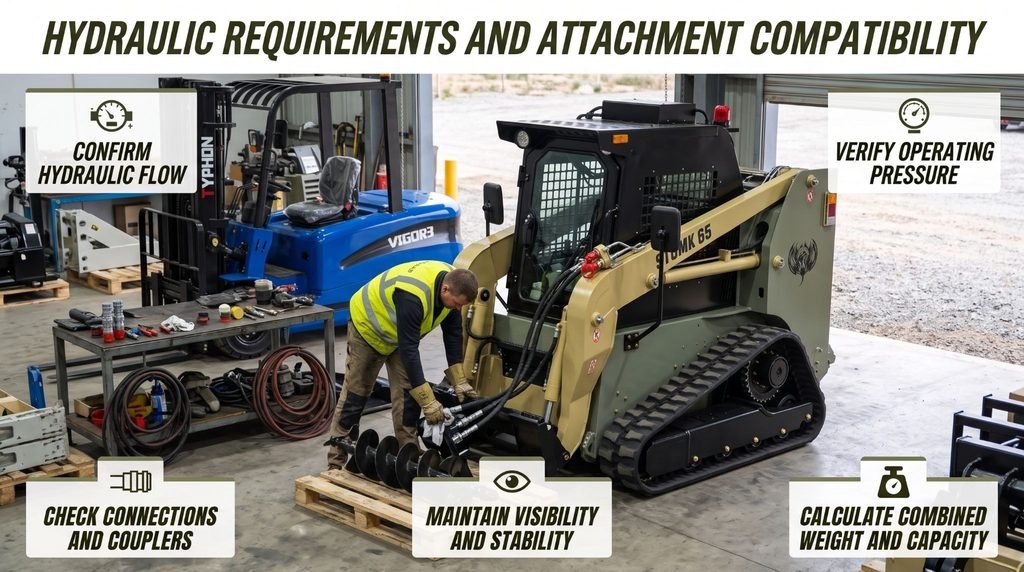
Hydraulic attachments perform as designed only when the machine supplies the right flow, pressure, and connection type. Skid steer loaders frequently run hydraulic tools, and many offer standard-flow or high-flow auxiliary circuits, so confirm which configuration your machine has. Forklift attachments such as sideshifters, fork positioners, and clamps also depend on auxiliary hydraulic functions and must be approved for the specific truck and installed according to the manufacturer’s instructions. Work through these five checks before connecting any attachment.
- Hydraulic Flow: Confirm the attachment’s required flow falls within the machine’s auxiliary circuit output to avoid sluggish operation and heat buildup.
- Operating Pressure: Verify the attachment is rated for the circuit’s pressure so it delivers its intended force without risking component damage.
- Connections and Couplers: Check that couplers, hoses, and connection types match, are clean, and are in good condition before every hookup.
- Combined Weight and Capacity: Calculate the total weight of the attachment and load, and confirm any change to rated capacity on the data plate or capacity chart.
- Visibility and Stability: Make sure the attachment doesn’t block the operator’s view of the load or travel path, and understand how it changes machine balance.
Key takeaway: Hydraulic attachments must match the machine’s flow, pressure, and connections, and every setup should be checked for combined weight, rated capacity changes, visibility, and stability before work begins.
Lifting Capacity and Load Stability
Rated capacity defines what a machine can handle safely under specified conditions. It reflects the manufacturer’s engineering of balance, structure, and hydraulics, and it should always be treated as a firm limit. Forklifts and skid steers express capacity differently, so operators and buyers need to understand both.
Forklift capacity depends on load center, lift height, mast configuration, and attachment weight. The load center is the horizontal distance from the fork face to the load’s center of gravity. When that distance grows, the load creates more leverage against the counterweight, and effective capacity drops. On many configurations, raising the load higher reduces capacity further. The forklift’s data plate states rated capacity at a specified load center and lift height, and it should reflect any attachment installed on the truck.
Skid steer loaders use a rated operating capacity, which manufacturers set as a defined portion of the machine’s tipping load. Load position matters just as much here. A pallet carried far out on the tines places more leverage on the machine than the same weight held close to the carriage. Lifting a heavy load high on uneven ground raises the center of gravity and reduces stability, which increases the risk of tipping.
On both machines, attachment weight reduces the load that can be carried, because a heavy clamp, grapple, or bucket uses part of the rated capacity before any material is added. Never assume an attachment increases lifting capability simply because it makes a load easier to grip. Follow the capacity chart for the complete configuration, keep loads centered and low during travel, and raise them only at the placement point.
Key takeaway: Forklift capacity changes with load center, lift height, mast configuration, and attachment weight, while skid steer capacity is tied to tipping load and load position, so always work from the capacity chart for the complete setup.
Surface Conditions and Jobsite Mobility
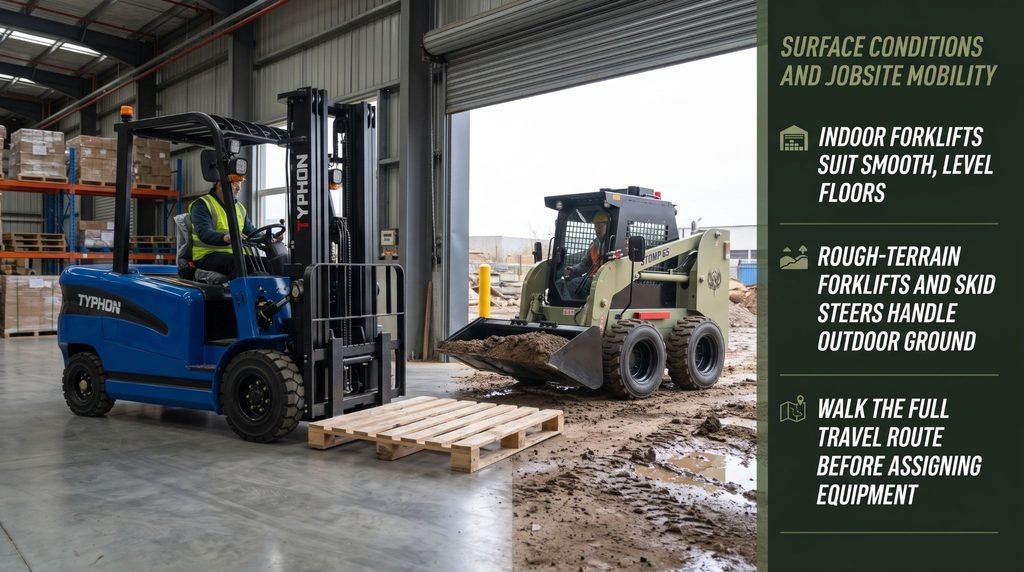
Lifting capability only matters if the machine can travel safely to the placement point. On many sites, ground conditions decide which machine can take the job before any load is lifted.
Forklifts perform best on surfaces suited to their tire type and design. Indoor warehouse forklifts usually run on cushion or solid tires built for smooth, level concrete. They turn tightly and position accurately in aisles, but they aren’t designed for gravel, mud, or rutted ground. Rough-terrain forklifts use larger pneumatic tires, more ground clearance, and sturdier drive systems for outdoor construction and agricultural work. Putting the wrong forklift type on the wrong surface can lead to lost traction, load instability, or a machine stuck halfway along its route.
Skid steer loaders handle many construction and landscaping surfaces when equipped appropriately. Wheeled models suit firm ground, paving, and compacted yards, and they often perform well when a job involves frequent travel. Compact track loaders spread weight across tracks and may offer better traction on soft or uneven terrain. Even so, mud, loose soil, slopes, and uneven ground still affect safe operation, especially when the machine is carrying a heavy or raised load.
Base equipment selection on the actual travel route, not only on the lift itself. Walk the path from pickup to drop-off and note slopes, soft areas, curbs, ramps, doorways, overhead obstructions, and pedestrian zones. A forklift may be the ideal machine at the destination, but if the route crosses wet clay, a skid steer or rough-terrain forklift may be the only practical and safe option.
Key takeaway: Indoor forklifts belong on smooth floors, while rough-terrain forklifts and properly equipped skid steers handle outdoor ground, so let the full travel route guide which machine you assign.
Choosing the Right Equipment for the Job
The right machine is the one that fits the work you perform most often. A forklift is usually the stronger choice for stacking pallets, loading and unloading trucks, and placing goods at specified heights. A skid steer loader is often more practical for moving bulk materials, clearing debris, grading ground, and carrying loads across a construction site with compatible attachments.
Many operations get the best results by using both machines for separate tasks. On a commercial build, a rough-terrain forklift may unload and stage palletized materials while a skid steer prepares the ground, moves aggregate, and cleans up. In a farm or industrial setting, a forklift may handle stacking and dock work while a skid steer manages bulk material and site maintenance.
Before you buy or assign equipment, compare the operating environment, load characteristics, required lift height, and attachment availability. Factor in maintenance requirements, service access, and parts availability, since downtime affects every job that depends on the machine. Operator training also matters. Forklift and skid steer operation each require specific training, and operators must understand the capacity limits and handling characteristics of every attachment they use.
Whenever possible, arrange a demonstration with your own materials and attachments on representative ground. Watching the machine handle real loads along your actual routes gives a clearer answer than any specification sheet. It also lets your operators judge controls, visibility, and comfort before you commit.
Key takeaway: Choose a forklift for stacking, truck loading, and elevated placement, and a skid steer for bulk material, grading, and versatile site work, while weighing environment, load type, lift height, attachments, maintenance, and training.
Conclusion
Forklifts and skid steer loaders each bring distinct strengths to material handling, and the safest, most productive operations match every machine and attachment to the work it was built to perform: forklifts specialize in lifting, carrying, and positioning compatible loads with precision at height, while skid steers deliver versatile ground-level performance across changing sites; forklift attachments refine how loads are gripped and placed, while skid steer attachments widen the range of jobs one machine can cover; forklift capacity depends on load center, lift height, mast configuration, and attachment weight, while skid steer capacity is tied to tipping load and load position; indoor forklifts belong on smooth floors, while rough-terrain forklifts and properly equipped skid steers handle outdoor ground; hydraulic attachments must match each machine’s flow, pressure, and connections; and the final decision should reflect operating environment, load characteristics, lift height, attachment availability, maintenance, and operator training. Before you assign equipment or make a purchase, walk the full travel route from pickup to placement, list the loads and materials you handle most often, confirm how high they need to be placed, check rated capacity for every attachment configuration, verify hydraulic compatibility, plan training for each operator, and arrange a demonstration with your own materials so your decision reflects how the machine performs on your sites.
Frequently Asked Questions
Can a skid steer loader replace a forklift?
Not in every application. A skid steer with approved pallet forks can carry many palletized loads around a construction site or yard. It may not provide the lift height, positioning precision, or capacity needed for warehouse stacking, racking, or loading trucks at height.
Which attachments are common for forklifts?
Common forklift attachments include sideshifters, fork positioners, fork extensions, and clamps. Specialized approved attachments are also available for loads such as rolls, bales, and drums. Each attachment must be approved for the specific truck, and its effect on rated capacity should be reflected on the data plate.
Do attachments affect lifting capacity?
Yes. Attachment weight, load center, and attachment design can reduce available rated capacity on both forklifts and skid steers. Always follow the manufacturer’s capacity information for the complete machine and attachment configuration.
Which machine is better for construction material handling?
The choice depends on the task. Forklifts, particularly rough-terrain models, suit palletized loads and elevated placement. Skid steer loaders are better suited to bulk materials, ground preparation, debris cleanup, and hydraulic attachment work across a changing site.