
How to Reduce Fuel Use During Wheel Loader Operation
Fuel is one of the largest variable costs in wheel loader operation, but consumption is determined by far more than engine displacement or horsepower. Engine load, hydraulic demand, drivetrain resistance, operating RPM, tire condition, and work-cycle efficiency all influence how much fuel is required to produce useful work. When the engine repeatedly operates above the power level required by the hydraulic system or drivetrain, fuel is converted into excess heat and mechanical losses rather than productive output.
Reducing fuel consumption therefore starts with controlling unnecessary engine load while maintaining production. Efficient throttle management, lower unnecessary RPM, reduced idle time, properly maintained hydraulic and fuel systems, correct tire pressure, optimized loading cycles, and matching the loader’s size and powertrain to the application can improve fuel efficiency without sacrificing cycle time. Even relatively small reductions in fuel use become significant when multiplied across daily operating hours, annual machine utilization, and an entire fleet.
Operator Technique Is the Biggest Lever You Control
More than any single setting, the person in the seat decides how much fuel a wheel loader burns. Two operators running identical machines on the same pile can post fuel numbers 20 to 30 percent apart, purely from how they approach each cycle, which makes technique the easiest money on the site to recover. The core principle is simple: smooth, deliberate movements beat aggressive ones every time. Ramming the bucket into the pile at full throttle spins the tires, wastes fuel, and wears the drivetrain, while a measured approach with steady throttle fills the bucket cleanly.
A handful of habits deliver outsized results, and they all reinforce that same idea of letting the machine do the work rather than forcing it. Easing off the throttle the moment the tires break traction stops fuel from vanishing into wheels that spin without moving anything. Filling the bucket in one clean pass avoids the crowding and re-digging that doubles the effort for the same load. Feathering the throttle to match engine speed to the task keeps the machine from running wide open through every motion, and braking and accelerating gently spares both fuel and components from the strain of hard starts and stops. Coaching these habits into daily routine pays back faster than any hardware upgrade you could buy.
Managing Engine Load and RPM for Efficiency
Running the engine at full throttle all day feels productive, but it often wastes diesel. A wheel loader engine has a sweet spot, a mid-range RPM band where it delivers the most work per gallon. Holding the machine there instead of redlining it trims consumption on nearly every cycle. Modern loaders make this easier than it sounds, since many respond better to steady, moderate throttle than to constant full power. The hydraulics and transmission are tuned to perform in that efficient range, so pushing beyond it usually adds fuel burn and heat without adding real output.
The practical move is to match engine speed to the job in front of you. Light material handling and travel rarely need full throttle, so backing off the pedal during those tasks saves fuel with no loss of productivity. Reserve high RPM for the moments that genuinely demand it, like digging into a compacted face, and you’ll buy only the power the work actually requires rather than paying for output the task never uses.
Cutting Idle Time Before It Drains the Tank
Idling is fuel spent for nothing, and it accumulates faster than most crews realize. A wheel loader left running through breaks, waiting for trucks, or parked between tasks can burn a half-gallon to a full gallon of diesel every hour while accomplishing zero work. Spread that across a fleet and a season, and thousands of dollars disappear. Excessive idling also dilutes engine oil, loads the exhaust aftertreatment system, and piles meaningless hours onto the machine, so the cost reaches well beyond the fuel bill itself.
The fix costs nothing but discipline. Shutting the machine down whenever it will sit for more than a few minutes, during long waits, breaks, or delays, turns wasted fuel straight into savings, and a quick restart costs far less than minutes of needless idling. The machine helps you here, too: most current loaders can drop to low idle or shut off automatically after a set idle period, so enabling those auto-idle and auto-shutdown features makes the savings automatic. It also pays to plan around truck cycles, because a loader that routinely waits on haul trucks can often be re-staged so it works instead of idles. Set a clear site policy that makes shutdown the norm, and the habit protects your budget every shift.
Tire Pressure and Maintenance That Protect Fuel Economy
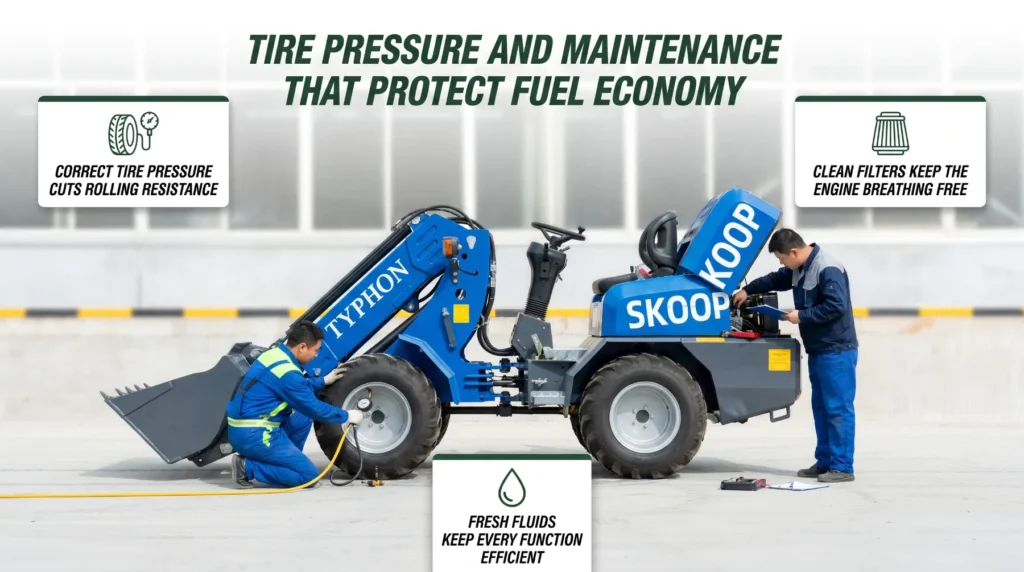
A neglected machine quietly burns more fuel with every pass, and tires are the clearest example. Underinflated tires increase rolling resistance, forcing the engine to work harder just to move the loader, and even a modest pressure drop can measurably raise consumption. Checking pressures regularly against the manufacturer’s specification, and correcting them before each shift when possible, is one of the simplest efficiency habits you can build.
Maintenance across the rest of the machine follows the same logic, since each small neglect stacks onto the fuel bill. Clogged air filters starve the engine and hurt combustion efficiency, dirty fuel filters restrict flow, and low or degraded hydraulic fluid makes every function labor harder than it should. A sound routine keeps tires checked daily and inspected for efficiency-robbing wear, keeps the air filter inspected and replaced on schedule so the engine breathes freely, keeps fuel and hydraulic filters clean for smooth flow, holds engine and hydraulic fluids at correct levels and change intervals, and keeps the cooling system clean so the engine runs at its efficient temperature. None of this is a pure cost center, either. A well-serviced loader burns less fuel, breaks down less, and lasts longer, so the routine pays for itself many times over.
Smarter Route and Cycle Planning
How you organize the work zone can matter as much as how you run the machine. A wheel loader spends much of its day traveling between the dig point and the load target, and every extra foot of that travel burns fuel, which makes shortening and smoothing those cycles one of the most overlooked ways to cut consumption. The classic illustration is the choice between a tight V-cycle and load-and-carry work. Positioning trucks close to the material face lets the loader work an efficient V-pattern instead of hauling loads over distance, slashing both travel time and fuel per cycle, so whenever the layout allows, it pays to bring the load target to the machine rather than driving the machine to it.
Grade and ground conditions count just as much. Working uphill or across soft, rutted ground forces the engine to burn extra fuel fighting resistance, so maintaining haul paths and staging on firm, level ground delivers a direct return. Plan the shortest practical path, keep it smooth, and minimize the sharp turns and reversing that waste motion, and you’ll find that fewer wasted movements translate straight into lower fuel use.
Right-Sizing the Machine for the Job
Choosing the wrong-size loader locks in poor fuel economy before the engine even starts. A machine too small for the work runs near its limit all day, burning fuel inefficiently as it strains to keep pace, while a machine far larger than the job needs hauls extra weight and engine capacity you never use, wasting diesel on every pass. The goal is a genuine match between machine and task, sizing the loader to your typical material, bucket loads, and cycle so it works comfortably in its efficient range rather than at either extreme.
Bucket selection deserves the same attention, because a bucket matched to the material density fills cleanly in one pass, while a mismatched one forces re-digging or carries less than the machine could handle. For fleet managers, this decision starts at procurement and rental, where assigning the right class of loader to each site, instead of forcing one machine to cover jobs it isn’t suited for, protects efficiency across the whole operation. A well-matched loader delivers the same production on noticeably less fuel.
Putting Modern Fuel-Saving Technology to Work
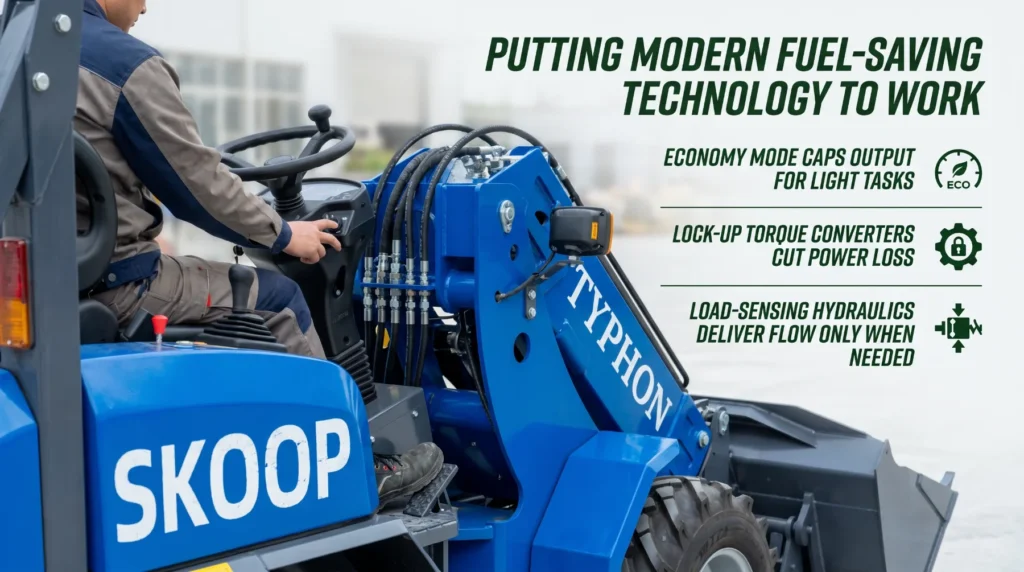
Today’s wheel loaders arrive with tools engineered to save fuel, and using them fully multiplies every other effort on this list. Many machines offer selectable power modes or economy settings that cap output for lighter tasks, cutting consumption without hurting productivity on the jobs that don’t need full power, so switching to economy mode whenever the work allows is a simple win. Alongside those modes, efficient transmissions with lock-up torque converters transmit power with less loss, and load-sensing hydraulics deliver flow only when a function actually needs it, all of it quietly protecting efficiency while you work.
Telematics turn guesswork into data. Onboard systems track fuel burn, idle time, and cycle efficiency for each machine and operator, giving fleet managers a clear view of which loaders and habits are driving up costs so they can coach them directly. Reviewing those reports regularly is one of the highest-return actions a manager can take. The essential point is not to leave any of this switched off or ignored, because the fuel-saving hardware is already paid for. Activating and using it, the auto-idle and shutdown features, the economy and power modes, the load-sensing hydraulics, and the telematics data, is free savings that compounds every other improvement you make.
Conclusion
Fuel consumption in a wheel loader is primarily influenced by engine operating point, hydraulic demand, drivetrain load, and duty-cycle efficiency, so reducing fuel use depends on keeping the powertrain within its most efficient operating range rather than simply reducing engine speed. Operator technique has a direct effect because aggressive acceleration, excessive throttle, wheel slip, unnecessary hydraulic cycling, and inefficient bucket loading increase transient engine load and fuel rate. Maintaining the engine near its manufacturer-specified efficient RPM range, minimizing idle periods, and using automatic engine shutdown where equipped can reduce fuel consumed without contributing to production. Tire inflation, air and fuel filter condition, engine lubrication, and cooling-system performance also affect efficiency by controlling rolling resistance and maintaining proper combustion and thermal conditions. Cycle planning should minimize unnecessary travel, repositioning, and partial bucket loads, while attachment and machine selection should reflect the required breakout force, hydraulic flow, lift capacity, and operating conditions. Fuel-saving functions such as power management, auto-idle, variable-speed hydraulics, and load-sensing systems can further reduce parasitic losses by adjusting engine and hydraulic output to actual demand. Consistent maintenance and operator monitoring are therefore essential for maintaining the loader’s intended fuel efficiency and production rate over its operating life.
Frequently Asked Questions
How much fuel can better operator technique actually save on a wheel loader?
Quite a lot. Two operators running the same machine on the same task can differ in fuel use by 20 to 30 percent, driven entirely by technique. Smooth throttle control, clean single-pass bucket loading, and avoiding tire spin make the biggest difference. Because it costs nothing but training and attention, coaching efficient technique is usually the fastest, highest-return way to cut fuel consumption, often more effective than any single equipment change you could make.
Is it really worth shutting the loader down instead of letting it idle?
Yes. A wheel loader can burn roughly a half-gallon to a full gallon of diesel per hour at idle while doing no work, and that adds up fast across a fleet and a season. Excessive idling also dilutes engine oil, burdens the emissions system, and piles meaningless hours onto the machine. For any wait longer than a few minutes, shutting down saves far more than a restart costs, and enabling auto-idle and auto-shutdown features makes those savings automatic.
Does tire pressure make a noticeable difference in fuel consumption?
It does. Underinflated tires raise rolling resistance, forcing the engine to work harder just to move the machine, which measurably increases fuel use over a shift. Checking pressures against the manufacturer’s specification and correcting them regularly is a quick, low-cost habit that protects fuel economy. Paired with clean air and fuel filters and proper fluid levels, correct tire pressure keeps the loader running at the efficiency it was designed to deliver.