
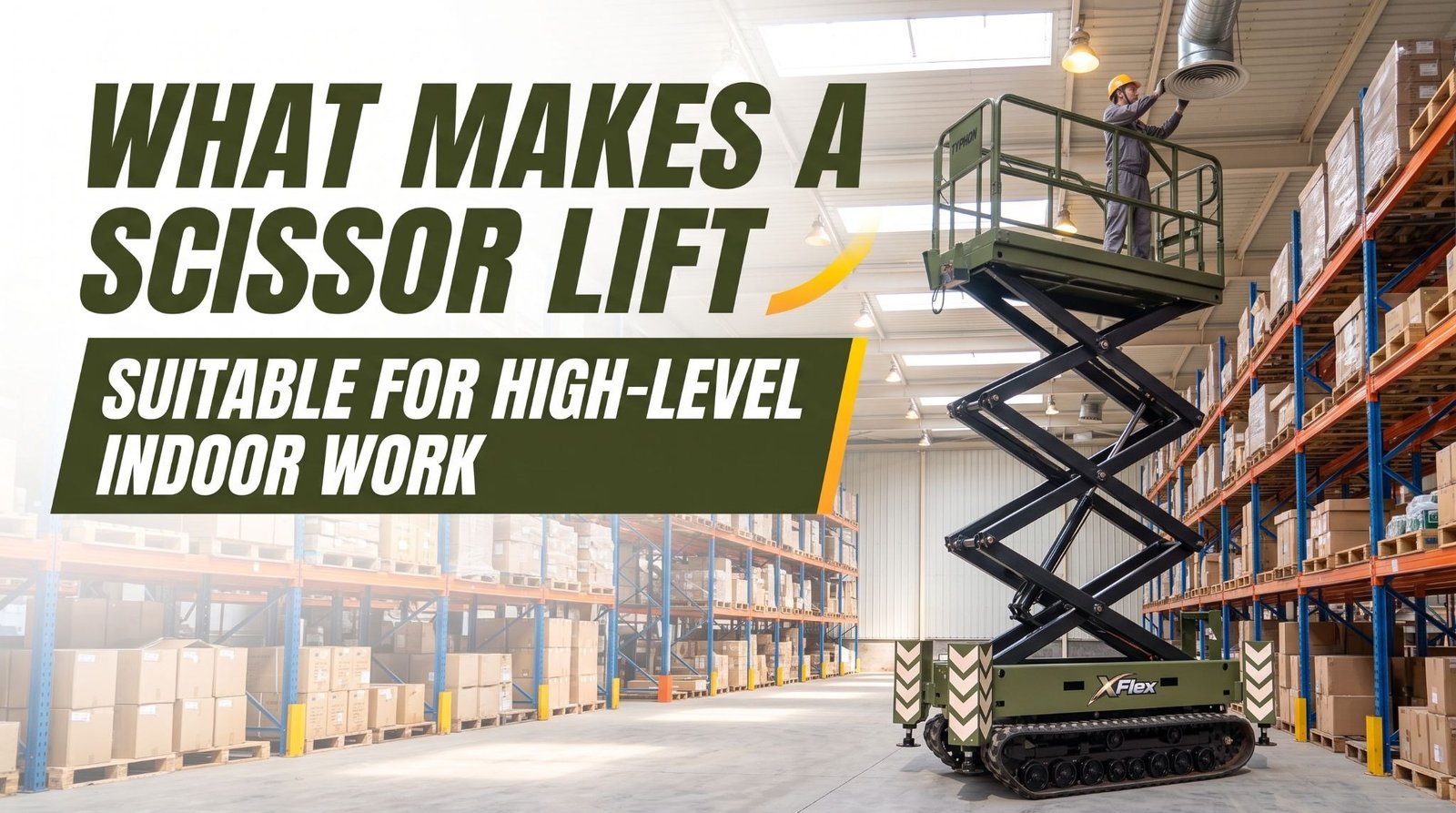
What Makes a Scissor Lift Suitable for High-Level Indoor Work
Before the warehouse shift begins, a maintenance crew faces a list of overhead tasks that cannot be handled from floor level. High-bay light fixtures need replacing, ceiling utilities require inspection, and overhead conduit needs attention. Bringing in large access equipment may create its own problems, especially when the machine must pass through narrow doors, move around storage racks, and travel across finished concrete. An indoor scissor lift offers a more practical setup when the job requires vertical access while keeping the equipment compact, maneuverable, and suitable for finished indoor floors.
Height alone does not determine whether a scissor lift works well inside a building. Overall width, machine weight, turning space, floor protection, platform capacity, and drive performance can all affect how easily the equipment moves through the facility. A lift may reach the required elevation but still become impractical if it cannot clear a doorway, navigate between racks, or operate safely on the available surface.
For high-level indoor maintenance, the machine needs to match both the building and the task. Compact dimensions can simplify movement through restricted areas, while non-marking tires help protect finished flooring during repeated repositioning. Platform capacity and working height also need to support the crew, tools, and required access range without exceeding the machine’s limits. Looking at these features together provides a more practical way to identify a scissor lift suited to demanding indoor work.
Compact Overall Dimensions
Indoor environments are defined by their constraints. Narrow aisles, standard doorways, structural columns, low-hanging obstacles, and tightly packed racking all limit where a machine can go and how it can move. A scissor lift that looks perfect on a spec sheet becomes useless the moment it can’t clear a doorway or turn down an aisle. That’s why compact overall dimensions sit at the top of the list for indoor suitability.
A compact machine does two things well. First, it fits through the building’s access points, meaning standard doorways, roll-up doors, and passages between fixed obstacles. Second, it maneuvers within restricted areas once inside, reducing the space needed to position the platform and turn around. In a busy warehouse, that compactness lets the crew reach fixtures tucked between racks or against walls without shutting down half the aisle. The smaller footprint also means less disruption to ongoing operations, which matters when the facility can’t simply stop working while maintenance happens overhead.
Key takeaway: A compact scissor lift fits through indoor access points and maneuvers in tight aisles, making it possible to reach work that a larger machine simply can’t approach.
Electric Power Systems
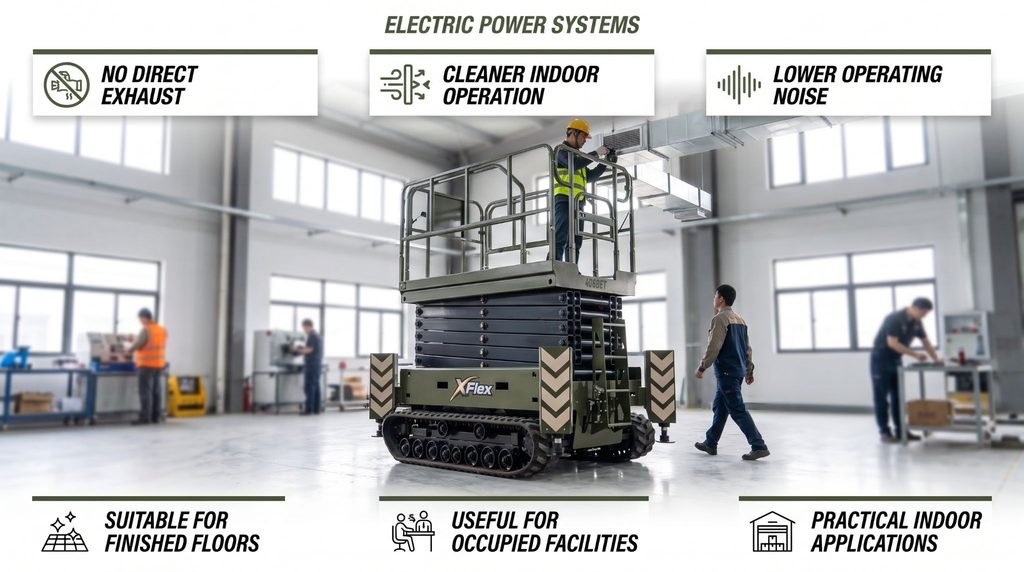
Power source is one of the main factors separating indoor lift applications from outdoor work. Enclosed buildings require equipment that does not introduce engine exhaust into occupied spaces, which is why battery-powered electric scissor lifts are widely used for indoor maintenance, construction, facility work, and installation tasks. Their power system also offers lower operating noise and avoids the fuel handling associated with combustion-powered machines.
- No direct exhaust: Electric scissor lifts run from battery power and do not produce direct engine exhaust at the point of use, making them suitable for enclosed work areas.
- Cleaner indoor operation: Without combustion exhaust, electric lifts can operate in warehouses, commercial buildings, and other enclosed spaces without adding engine fumes to the working environment.
- Lower operating noise: Electric drive and lifting systems generally operate more quietly than combustion-powered equipment, which can be useful in occupied buildings where noise needs to be controlled.
- Suitable for finished floors: Electric lifts do not require diesel or gasoline for operation, reducing concerns associated with fuel handling and combustion-fluid leaks during indoor work.
- Useful for occupied facilities: Maintenance crews can use electric lifts for lighting, electrical, HVAC, installation, and repair work while other employees continue working in the surrounding area.
- Practical indoor applications: Warehouses, distribution centers, commercial buildings, and facility maintenance areas are common environments where electric scissor lifts can provide elevated access without direct engine emissions.
Key takeaway: Electric scissor lifts run on battery power with no direct exhaust, making them the standard choice for indoor warehouse, facility, and installation work.
Appropriate Platform Height
Height is where crews most often trip up, and the confusion comes down to two similar-sounding numbers. Platform height is the vertical distance from the floor to the platform deck when the lift is fully raised. Working height adds the operator’s practical overhead reach, usually estimated at about six feet, to that platform figure. So a lift with a 20-foot platform height typically offers a working height near 26 feet.
That distinction matters because your task is defined by where the work sits, not where the operator stands. If a light fixture hangs 25 feet up, you need to know the crew can reach 25 feet, which is a working-height question. Platform height, working height, and platform capacity should all be reviewed together, because a machine that reaches ceilings, overhead fixtures, ductwork, and utilities on paper still has to lift the operator, tools, and materials within its rated limits at that height. Measure the true height of your work surface first, then work backward to the platform height you need, with a sensible margin built in.
Key takeaway: Platform height measures the deck, while working height adds operator reach, so plan around working height to confirm the crew can actually reach overhead fixtures and ductwork.
Low Floor Loading
Indoor jobs almost always happen on finished floors, and those floors have limits. Commercial buildings, multi-level facilities, and warehouses with rated slabs or floors over occupied space below all carry specific load restrictions. Roll a machine onto that surface without checking, and you risk cracking the floor, damaging what’s beneath it, or creating a genuine safety problem.
Two figures deserve attention here: the machine’s total operating weight and its wheel loading, which is how that weight concentrates through each wheel onto the floor. A heavier lift, or one that puts high point loads through small wheels, can exceed what a finished floor is rated to handle even if the overall weight seems reasonable. Before moving an elevated work platform across any indoor surface, check the machine’s operating weight and wheel loading against the floor’s rated capacity, and follow the manufacturer’s guidance. On multi-level or specialized floors, that check isn’t optional; it’s what protects both the building and the crew.
Key takeaway: Finished and rated floors have load limits, so check the lift’s operating weight and wheel loading against the floor’s capacity before driving onto the surface.
Smooth Drive Control
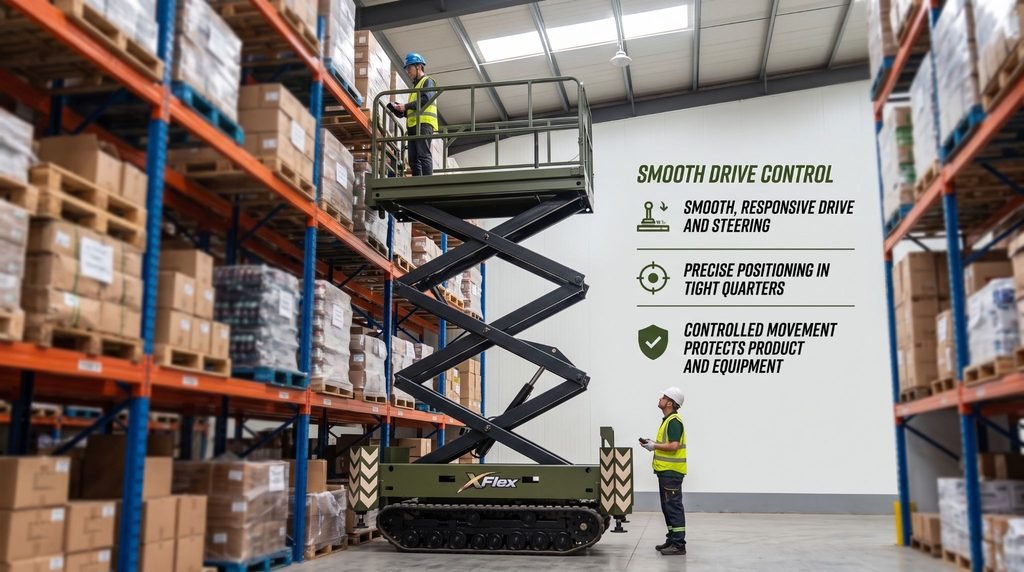
Reaching the work is only half the job; positioning the platform precisely is the other half. Indoor spaces are full of things a machine must not touch, including shelving stocked with product, walls, installed equipment, and other fixed structures. A lift with smooth, responsive drive and steering lets the operator ease into position accurately, while a machine with jerky or imprecise controls turns every repositioning into a risk.
Precise travel and steering pay off most in tight quarters. Nudging the platform a few inches to line up under a fixture, threading between racking, or creeping alongside a wall all demand controlled, predictable movement. Good drive control lets the operator make those fine adjustments without overshooting or making contact with surrounding structures, which keeps both the machine and the facility’s contents safe. In an active warehouse where product and equipment surround the work zone, that control is the difference between a clean job and an expensive scrape.
Key takeaway: Precise, smooth drive and steering let operators position the platform accurately around shelving, walls, and equipment without unnecessary contact.
Platform Capacity and Space
The platform itself decides how well the crew can actually work once elevated. Every lift carries a rated capacity, which is the maximum combined weight of the operator, tools, and permitted materials the platform can safely hold. Exceeding it compromises stability, so the platform has to accommodate everyone and everything the task requires while staying within that limit. A lift that reaches the height but can’t carry the crew plus their gear isn’t suited to the job.
Platform size works alongside capacity. A deck with enough room lets workers position themselves comfortably, stage their tools, and hold materials without crowding, which keeps the job moving and reduces trips up and down. At the same time, the platform has to remain appropriate for the indoor workspace, since an oversized deck can be as much a problem as a cramped one in a tight facility. Many lifts offer extending deck sections that add reach for spot work without repositioning the whole machine, which can be useful indoors. The goal is a platform sized to the task and the space at once: big enough to work on, contained enough to fit.
Key takeaway: Match platform capacity and size to the operator, tools, and materials the task requires, while keeping the deck appropriate for the indoor space.
Conclusion
Indoor scissor lift selection depends on more than maximum elevation because machine dimensions, power source, floor loading, control characteristics, and platform capacity must match the building and work requirements. Compact overall dimensions allow the lift to pass through doorways and maneuver within narrow aisles, while electric power provides operation without direct exhaust emissions, making it suitable for enclosed environments where ventilation is limited. Platform height and working height should correspond to the actual elevation of the task, while machine weight and wheel loading must remain within the permitted floor capacity to avoid damaging finished surfaces or exceeding structural limits. Smooth drive and steering control support precise positioning around walls, shelving, equipment, and other indoor obstacles. Platform dimensions and rated capacity must also accommodate the operator, tools, and materials without exceeding manufacturer limits. Before selecting a lift, operators should verify doorway and aisle dimensions, turning space, floor load limits, required working height, platform capacity, and available operating space. Matching these specifications to the building and duty cycle helps ensure reliable and controlled elevated access in indoor applications.
Frequently Asked Questions
What type of scissor lift is suitable for indoor work?
Electric scissor lifts are commonly used indoors because they produce no direct engine exhaust and operate more quietly than combustion models. They suit warehouses, commercial buildings, facility maintenance, and installation work. Before selecting one, also check its dimensions, floor loading, platform height, and capacity for the building and task.
Why is machine width important indoors?
Machine width determines whether the lift can pass through doorways, aisles, and narrow passages to reach the work area. Measure the narrowest points along the travel route, including access doors and spaces around columns or racks. Then compare those measurements with the lift’s overall width and maneuvering space.
How high can an indoor scissor lift reach?
Height varies by model, so compare platform height and working height with your actual task. Platform height measures the deck’s height, while working height includes the operator’s practical overhead reach, often around 6 feet. For example, a 20-foot platform height may provide about 26 feet of working height. Also confirm the lift can carry the required workers and tools at that height.
Can a scissor lift be used on finished floors?
Yes, provided the floor can support the machine and the manufacturer’s requirements are met. Check both the lift’s operating weight and wheel loading, since concentrated wheel loads can affect floor suitability. Electric models are generally clean for finished floors, but always verify the floor’s load rating before operation, especially on upper levels.