
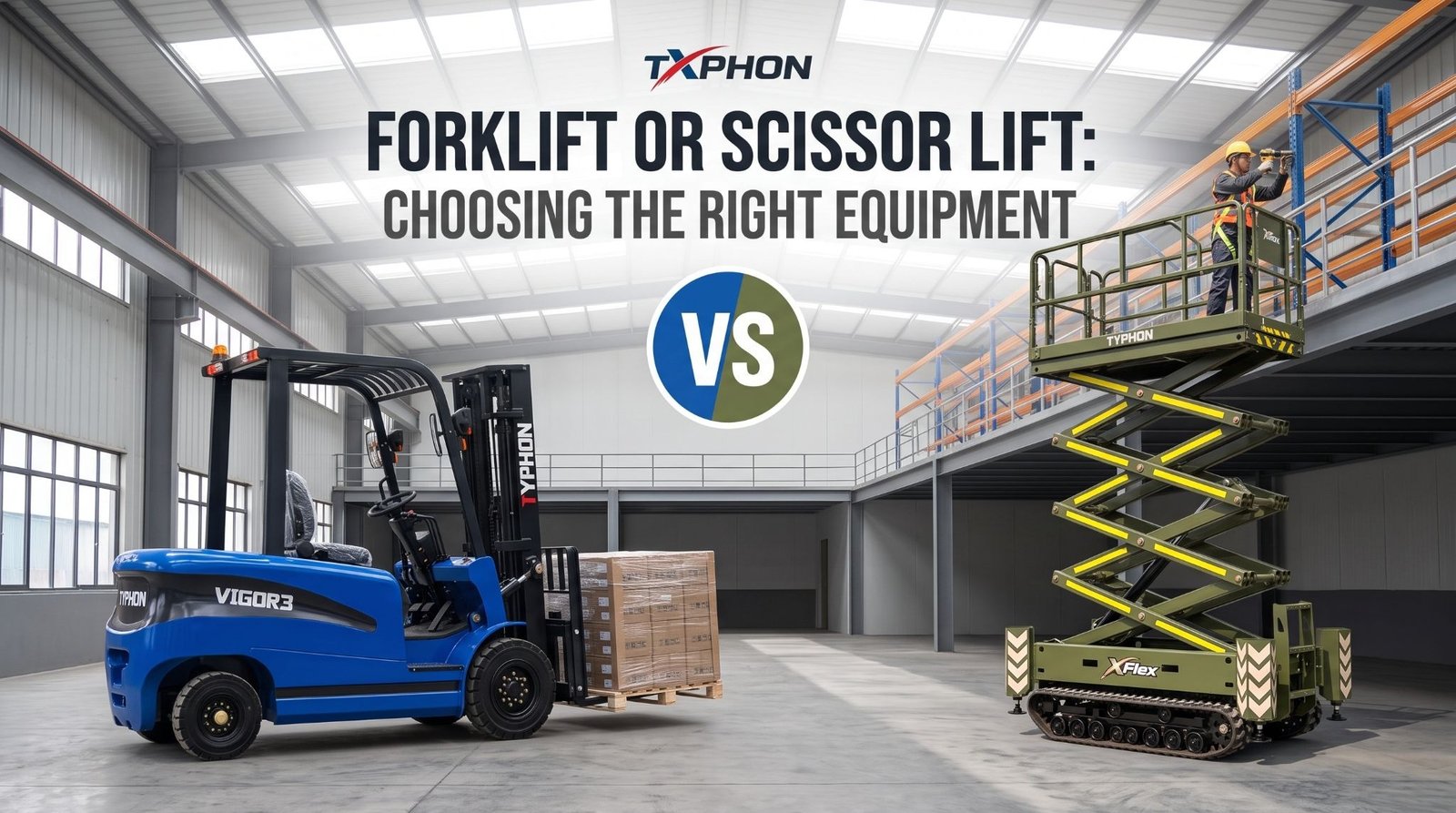
Forklift vs. Scissor Lift: Choosing the Right Equipment for Material Handling?
A warehouse manager finishing a mezzanine expansion orders a scissor lift to move pallets of stock up to the new level, figuring a lift is a lift. Two days in, the crew is hand-carrying every box onto the platform and back off at the top, because the machine rises straight up and does nothing to carry a load across the floor. A forklift would have staged those pallets in minutes, yet it can’t give a worker a stable platform to install the new racking overhead. One project, two very different jobs, and one costly assumption that the wrong machine could cover both. That mix-up is exactly why the choice deserves real thought before the purchase order goes out.
Picking between these two machines starts with understanding that they solve opposite problems. Forklifts move loads horizontally and lift them onto racks, while scissor lifts raise people and their tools safely to work at height. Both belong in material handling, but pointing one at the other’s job wastes money and slows the whole operation. This guide breaks down the core difference in plain terms, what each machine does best, how to match either one to your environment, the criteria worth comparing before you commit, and the return each delivers. Here’s how to choose with confidence.
The Split That Decides Everything
Strip away the specs and the divide is simple. A forklift is a load mover, built to lift material on a set of forks, carry it across a floor or yard, and stack it onto shelving. A scissor lift is a work platform, built to raise a person and their tools straight up to a stable, railed deck so they can reach overhead. One transports goods; the other elevates workers.
That single distinction drives every other decision you’ll make. Forklifts travel with a load and place it, so their whole design centers on lifting capacity, reach height, and stability while carrying weight forward. Scissor lifts stay put once positioned and rise vertically, so their design centers on platform size, safe working height, and a steady base while someone works from the deck.
Here’s the takeaway worth locking in early: these machines rarely substitute for each other. Using a scissor lift for workers and a forklift for pallets keeps each machine in the role it was built for. Match the machine to the actual task, and the rest of the choice falls into place quickly.
Where a Forklift Pulls Ahead
Moving material from point to point is where a forklift earns its keep, and nothing else in the yard touches it for that job. Loading trucks, unloading deliveries, staging pallets, and shuttling goods across a warehouse floor all fall squarely in its wheelhouse. One operator handles in minutes what a crew with pallet jacks would grind through all morning.
Vertical stacking is the second half of the story. Beyond carrying loads, a forklift raises them onto racking, feeds high shelves, and pulls stock back down when an order comes through, which keeps a warehouse dense and organized. Reach and capacity climb with the machine, so a properly sized unit stacks pallets several levels up without a second handling step. That combination of horizontal travel and vertical lift is exactly what storage operations lean on daily.
Heavy and outdoor work seals the case for a forklift. Rough-terrain and internal-combustion models handle gravel, docks, and lumber yards where weight and uneven ground would stall lighter equipment, and their high capacity moves loads a scissor lift could never lift, let alone carry. When the job is about muscle, distance, and stacking weight, the forklift is the tool. Its limit shows up the moment the task shifts to giving a worker safe footing at height, since that’s a job it was never designed to do.
Where a Scissor Lift Comes Into Its Own
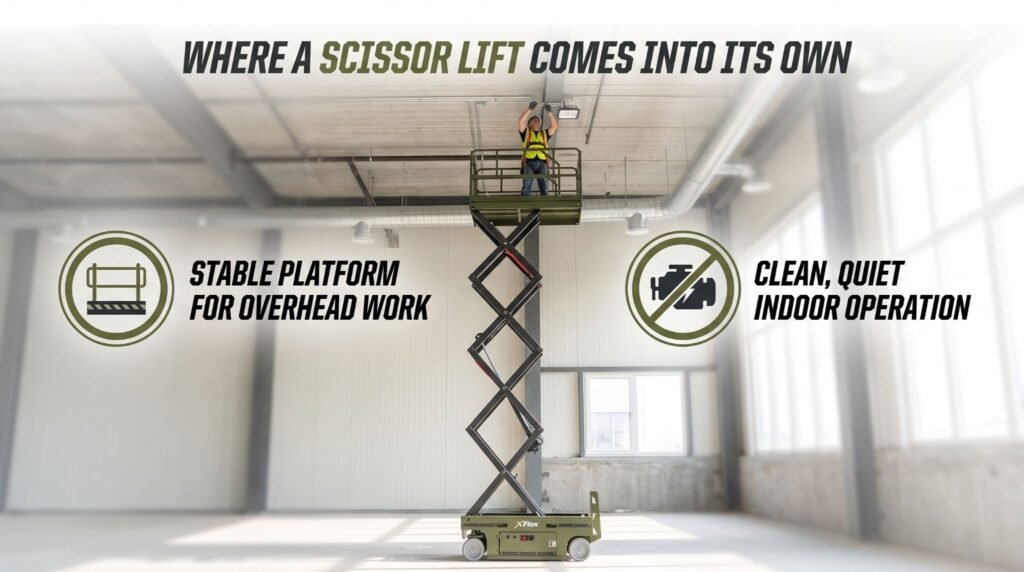
Reaching the work safely is the whole purpose of a scissor lift, and it delivers that better than any ladder or forklift ever could. Electrical, HVAC, painting, lighting, and fixture work all demand a worker standing steady at height with both hands free, and a railed platform provides exactly that. Rather than balancing on a ladder or stretching from scaffolding, a crew works from a solid, level deck.
Precision indoors is the second strength worth naming. Compact electric models thread through doorways and tight aisles, rise silently on active floors, and run clean without exhaust, which makes them a natural fit for retail spaces, warehouses, and occupied buildings. Non-marking tires protect finished floors as the machine repositions, so a crew works overhead without leaving a trace on the surface below.
Stability at height is the payoff that ties it together. A scissor lift raises a broad, guardrailed platform straight up, giving workers a repeatable, controlled way to handle overhead tasks all day without the fall risk a ladder invites. That said, the machine stays put once elevated and carries no load across the floor, so it won’t move your pallets or feed your racking. Point it at overhead access, though, and it turns risky reaching into routine work.
Reading the Job and the Environment
Matching the machine to the work starts with one honest question: are you moving material or reaching height? Loading trucks, stacking pallets, and hauling goods across a floor point straight to a forklift. Installing conduit, servicing ceiling units, or painting a wall points just as clearly to a scissor lift. Sort the task first, and the machine usually picks itself.
Environment shapes the choice nearly as much as the task. Indoor operations with clean floors, tight aisles, and enclosed air lean toward electric machines of either type, since exhaust and noise become real problems in closed space. Outdoor and rough-ground work favors the higher clearance and pneumatic tires of an internal-combustion forklift, while overhead work indoors calls for a compact electric scissor lift built for finished floors.
Consider a warehouse that both stores pallets and maintains its own overhead lighting and sprinkler lines. That operation genuinely needs both machines, a forklift for the racking and a scissor lift for the ceiling work, because neither one covers the other’s job. Trying to force a single machine across both tasks is the exact mistake that leaves a crew hand-carrying stock or stretching dangerously from the forks. Map your real tasks against your real space, and the right pairing becomes obvious.
Criteria Worth Weighing Before You Commit
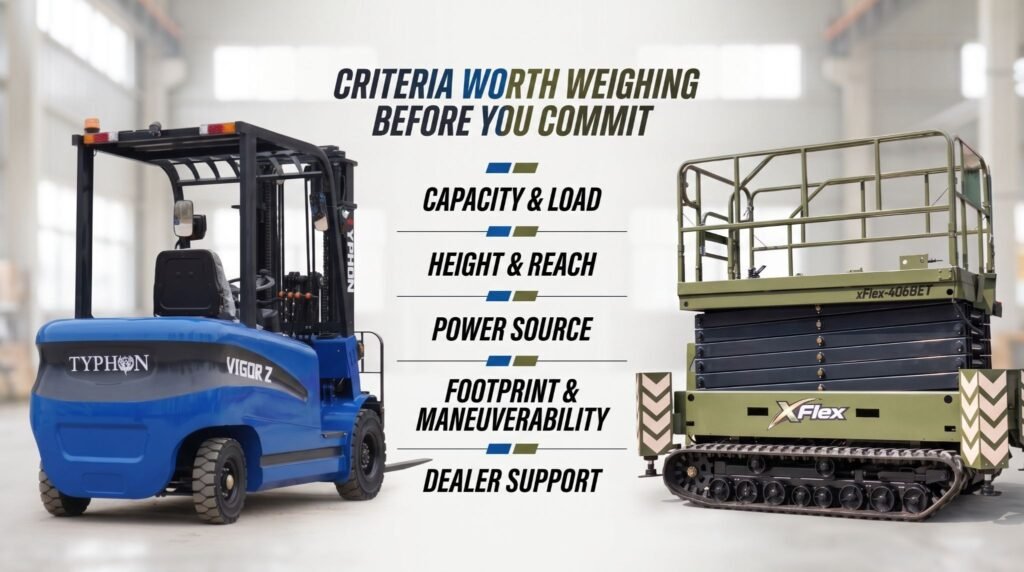
Several specs decide whether a machine fits your operation, so weigh them together rather than chasing one number. Ranking the following against your actual workload keeps the decision grounded:
- Capacity and load: For a forklift, match the rated capacity to your heaviest pallets and confirm it holds at the height you stack. For a scissor lift, check the platform weight limit covering workers, tools, and material combined.
- Height and reach: Confirm a forklift’s mast lifts to your top rack beam, and verify a scissor lift’s working height clears your ceilings with room to work safely.
- Power source: Electric runs clean and quiet for indoor use, while internal combustion supplies the muscle and quick refueling that heavy outdoor work demands. Match the fuel to the environment.
- Footprint and maneuverability: Measure your aisles and doorways, then match the machine’s width and turning radius to them. A unit that can’t navigate your space is no bargain at any price.
- Dealer support: Reliable parts and responsive service protect uptime far more than a low sticker. A machine that’s hard to service gets expensive fast.
Rank these by what constrains your operation most. A storage business fighting for rack space prioritizes forklift reach and capacity, while a maintenance crew working occupied buildings leans hardest on scissor lift height and a clean, quiet drivetrain. Reviewing your full requirements before you shop keeps every spec tied to a genuine need rather than a nice-to-have.
What Each Machine Returns on the Investment
Cost is the question every manager weighs first, and the return on each machine flows from how well it fits the work. A forklift pays back through the labor it replaces and the storage it unlocks, since one operator moving and stacking loads all day does the work of a much larger crew. Reaching full rack height also lets you hold more inventory in the same building, which delays the far larger expense of leasing new space.
Scissor lifts earn their keep through safety and speed at height. Setting up faster than scaffolding and offering far steadier footing than ladders, one machine trims labor hours on every overhead job while cutting the fall risk that drives up insurance and downtime. For a facility that services its own ceilings, lighting, and fixtures, a scissor lift turns risky, slow work into routine, repeatable tasks a crew handles quickly.
Whether buying beats renting comes down to how often you use each machine. Steady daily material handling usually justifies owning a forklift outright, while overhead work that surfaces only occasionally may favor renting a scissor lift for those stretches, so weighing your real hours against the purchase price keeps the spend lean. Whichever route fits, following a steady maintenance routine protects the investment, and training operators on safe practices protects your crew on every shift. Both machines reward an operation that matches the tool to the task and keeps it working within its limits.
Conclusion
Choosing between a forklift and a scissor lift comes down to what the work actually demands: moving material or reaching height. Forklifts carry loads across a floor or yard and stack them onto racking, which makes them the pick for loading, unloading, staging, and heavy outdoor handling. Scissor lifts raise a worker and tools to a stable, railed platform, which makes them the tool for electrical, HVAC, painting, and fixture work indoors. Match the machine to the task and the environment first, then compare capacity, height, power source, footprint, and dealer support against your real workload before you commit. Operations that need both should own both rather than forcing one machine into the other’s role. Weigh how much moving versus reaching your work involves, factor in whether buying or renting fits your hours, and keep either machine on a steady maintenance routine. When you’re ready to put dependable material handling equipment to work, reach out to a trusted equipment specialist who can pair a reliable machine with the results your operation depends on.
Frequently Asked Questions
What is the main difference between a forklift and a scissor lift?
A forklift moves and stacks material, lifting loads on forks and carrying them across a floor or yard onto racking, while a scissor lift raises a worker and their tools straight up to a stable, railed platform for overhead work. One transports goods; the other elevates people, so they rarely substitute for each other.
Can a scissor lift be used to move pallets or heavy loads?
No. A scissor lift is built to raise people and tools vertically to a work platform, not to carry material across a floor or lift heavy pallets onto shelving. Moving and stacking loads calls for a forklift sized to your weight and stacking height, since forcing a scissor lift into that role is unsafe and ineffective.
Do I need both a forklift and a scissor lift for my operation?
It depends on your work. Operations that only move and stack material need a forklift, while crews that only work at height need a scissor lift. Facilities that do both, such as a warehouse storing pallets and maintaining its own ceilings, genuinely benefit from owning each machine rather than forcing one to cover the other’s job.