
How Does Lead Acid Battery Power Affect Electric Forklift Runtime
Nothing stalls a shift faster than a forklift that runs out of charge before the work runs out. A truck that started the morning strongly slows by mid-afternoon, lifts feel sluggish, and the operator finds themselves watching the charge gauge instead of the load. Behind that familiar frustration sits a single component doing most of the work: the lead acid battery. On an electric forklift, this heavy pack is far more than a power source. It stores the energy every lift and every mile of travel depends on, and it doubles as a counterweight that keeps the truck balanced. How much work you get between charges, and how consistently the truck performs across a shift, comes down almost entirely to how that battery stores, releases, and holds its energy.
Understanding lead acid runtime protects both your productivity and your investment. A pack sized correctly and cared for well carries a full shift without complaint, while one that’s undersized, worn, or poorly charged leaves you short of hours when you need them most. This post walks through how lead acid batteries store and release energy, how capacity sets the runtime ceiling, how heavy work and temperature drain the pack, how charging habits and age erode usable capacity, how lead acid stacks up against lithium-ion, and how to match a battery to the real demands of your shift.
How a Lead Acid Battery Stores and Releases Energy
A lead acid forklift battery is a large assembly of individual cells, each containing lead plates submerged in a solution of sulfuric acid and water called the electrolyte. When the battery discharges to power the truck, a chemical reaction between the lead plates and the acid releases electrical energy, and in the process the plates gradually coat with lead sulfate while the electrolyte weakens. Charging reverses that reaction, driving the sulfate back off the plates and restoring the electrolyte to full strength so the pack is ready to work again. This back-and-forth chemistry is the heartbeat of every electric forklift running on lead acid power.
Because the process is chemical rather than instant, a few practical realities follow. The reaction takes time to reverse, which is why lead acid packs need a lengthy charge rather than a quick top-up, and it generates heat and gas during charging, which is why these batteries require ventilation and periodic watering to replace fluid lost in the process. The health of the plates and the strength of the electrolyte directly govern how much energy the pack can deliver, so a battery kept in good chemical condition holds its runtime while a neglected one fades. Grasping this foundation makes everything else about runtime easier to understand, because every factor that follows ultimately acts on this same chemistry.
Key takeaway: A lead acid battery releases energy through a reversible chemical reaction between lead plates and acid electrolyte, so the condition of that chemistry directly sets how much runtime the pack can deliver.
How Battery Capacity Sets the Runtime Ceiling
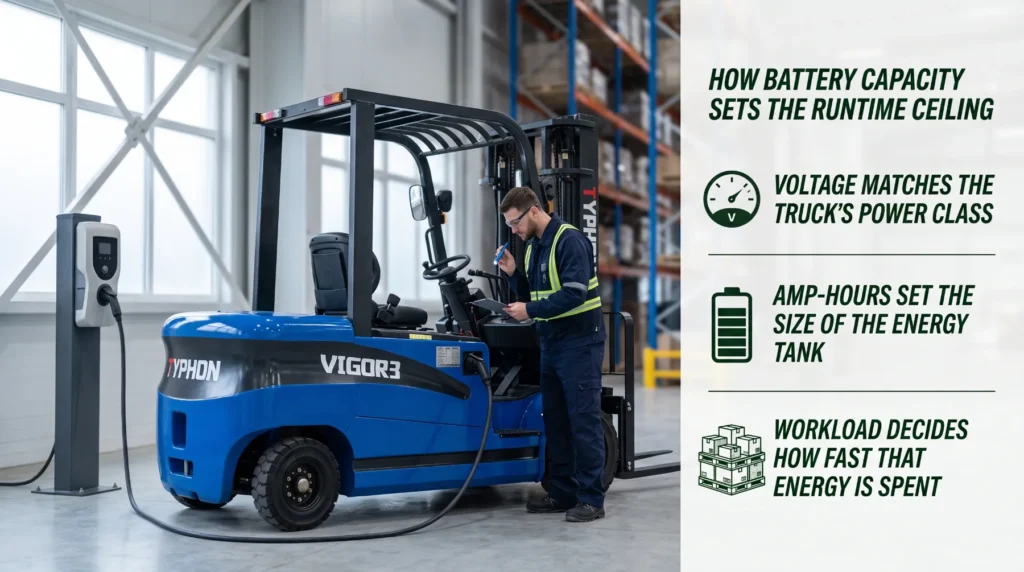
Two numbers on a forklift battery’s data plate tell you most of what you need to know about its runtime potential: voltage and amp-hour capacity. Voltage, commonly 24, 36, or 48 volts on electric forklifts, reflects the electrical force the pack supplies and generally matches the size and power class of the truck it serves. Amp-hours, by contrast, measure how much charge the battery holds, essentially the size of the energy tank. A pack rated at a higher amp-hour figure stores more energy and therefore runs longer before it needs charging, assuming the same workload. When operators ask how long a battery lasts on a charge, amp-hour capacity is usually the number that answers them.
Multiplying voltage by amp-hours gives the pack’s total energy in watt-hours, which is the truest measure of how much work it can do between charges. This matters because two batteries at the same voltage can hold very different amounts of energy depending on their amp-hour rating, and the larger one simply lasts longer under identical use. That said, capacity sets a ceiling rather than a guarantee. The actual hours you get depend on how hard the truck works against that stored energy, which is why two identical batteries can deliver very different runtimes in different operations. Capacity defines the potential; the workload decides how quickly you spend it.
Key takeaway: Voltage matches the battery to the truck’s power class while amp-hour capacity sets how much energy the pack holds, so higher amp-hours mean a higher runtime ceiling before recharging.
How Duty Cycle and Lift Intensity Drain the Pack Faster
Capacity tells you how much energy sits in the tank, but duty cycle decides how fast you burn through it. Duty cycle describes how hard and how continuously the forklift works across a shift. A truck that lifts heavy loads to full height repeatedly, travels long distances, and rarely sits idle draws energy far faster than one handling light loads with frequent pauses. Every lift, especially a heavy one raised high, pulls a strong surge of current from the battery, and those demanding cycles add up quickly over a shift. Two trucks with identical batteries can post very different runtimes simply because one works far harder than the other.
Lift intensity is the single biggest drain within that duty cycle. Raising a full load to a top beam asks the hydraulic motor to work hard against gravity, and that effort pulls heavily on the pack, draining it faster than traveling alone. Ramps and grades compound the demand, since driving a loaded truck uphill forces the drive motor to haul weight against gravity too. Cold storage, long travel distances, and constant high-cycle work all deepen the draw. This is why sizing a battery around your heaviest, busiest routine, rather than an average day, matters so much: the pack has to carry you through the toughest shifts, not just the easy ones. When you match capacity to your real workload, the truck holds its pace from clock-in to clock-out.
Key takeaway: A demanding duty cycle of heavy, frequent lifts and long travel drains a lead acid pack far faster than light, intermittent work, so runtime depends as much on how hard the truck works as on the battery’s capacity.
How Temperature Affects Lead Acid Performance
Lead acid batteries are sensitive to temperature, and the reason traces straight back to the chemistry that powers them. Because the pack releases energy through a chemical reaction, and reactions slow when they get cold, a lead acid battery delivers noticeably less of its stored energy in low temperatures. Work in a refrigerated warehouse or an unheated facility in winter, and the same battery that carries a full shift in mild conditions can surrender a meaningful share of its runtime. The colder it gets, the more pronounced the shortfall, which catches operations off guard when they assume the battery will perform in the cold the way it does at room temperature.
Heat cuts the other way and brings its own trouble. Warm conditions let the pack deliver its energy more freely in the short term, but sustained high temperatures accelerate the wear that permanently shortens a battery’s life. Charging generates heat as well, so a pack that is already hot from hard work and then charged without a chance to cool suffers added strain over time. Cold storage operations feel the runtime pinch most acutely, while hot climates pay more in shortened battery lifespan. Either way, planning around the temperature you actually work in, rather than an ideal, keeps you from being caught short at the worst moment.
Key takeaway: Cold temperatures slow the battery’s chemistry and cut usable runtime, while sustained heat speeds long-term wear, so the working environment directly shapes both the hours you get and the life of the pack.
How Charging Habits and Battery Age Reduce Usable Capacity
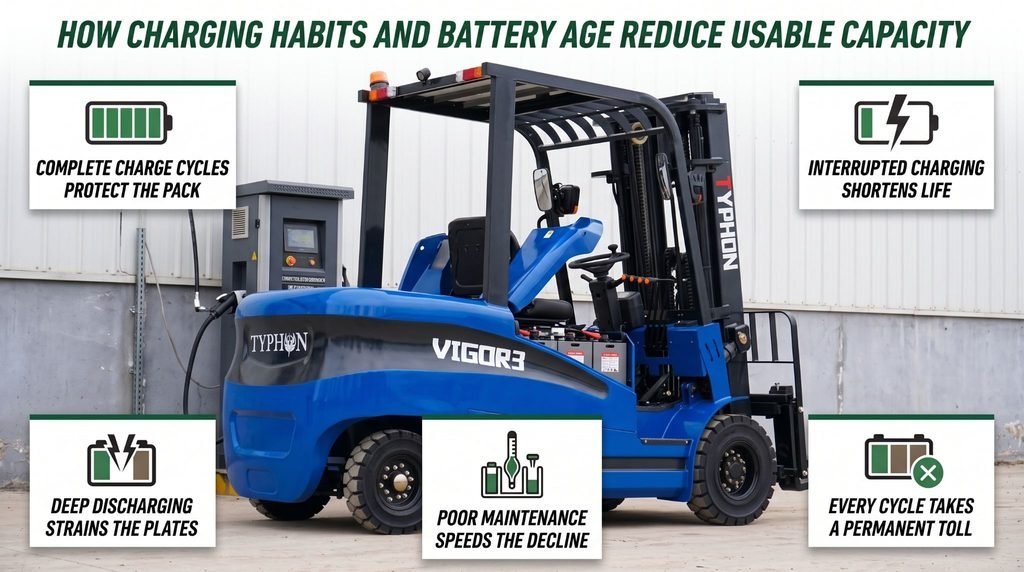
A lead acid battery doesn’t hold its full capacity forever, and how it’s charged has a great deal to do with how gracefully it ages. These packs perform best on a complete charge cycle, and repeatedly interrupting a charge or opportunity-charging in short bursts throughout the day can shorten their life, since lead acid chemistry isn’t designed for the frequent partial charging that other chemistries tolerate well. Deep discharging harms the pack too. Draining a lead acid battery far below its recommended limit, generally around 80 percent of capacity, strains the plates and accelerates wear, which is why operators are advised to recharge before the pack runs too low rather than squeezing out every last minute.
Age erodes capacity in a way no charging discipline can fully prevent. Every charge and discharge cycle takes a small, permanent toll, and over hundreds of cycles the plates gradually lose their ability to hold a full charge. A battery that carried an easy eight-hour shift when new may struggle to reach six or seven after years of service, even when charged perfectly, simply because its usable capacity has faded. Poor maintenance speeds this decline, as letting the electrolyte run low or allowing sulfate to build up on the plates permanently trims what the pack can deliver. This is why runtime should be judged against a battery’s real, current condition rather than its original rating, and why a tired pack nearing the end of its life often explains a truck that no longer lasts the shift.
Key takeaway: Incomplete charging, deep discharging, poor watering, and simple age all permanently reduce a lead acid battery’s usable capacity, so charging discipline and maintenance directly determine how long the pack holds its runtime over the years.
How Lead Acid Compares to Lithium-Ion for Runtime
Setting lead acid beside lithium-ion clarifies the trade-offs, because the two chemistries handle runtime and charging in genuinely different ways. Lead acid batteries are proven, widely supported, and considerably less expensive to buy, which keeps them the practical choice for a great many operations. On a single full charge, a properly sized lead acid pack carries a full shift dependably, and its weight serves as a useful counterweight for the truck. For single-shift operations that charge overnight and don’t push the truck to extremes, lead acid remains a sound, cost-effective foundation that has powered warehouses reliably for decades.
Lithium-ion tells a different story around charging flexibility and sustained output. These packs tolerate opportunity charging, accepting quick top-ups during breaks without the harm that partial charging inflicts on lead acid, which lets a single lithium battery keep a truck running across multiple shifts with only short charging windows. They hold their voltage more steadily as they discharge, so performance stays consistent rather than tapering, and they need no watering and generally handle cold better. The trade-off is a higher purchase price. Lead acid demands full charge cycles, a lengthy recharge, and often a spare pack and battery-swapping routine for heavy multi-shift work, whereas lithium sidesteps much of that at greater upfront cost. The honest decision rests on your shift pattern and budget: lead acid suits single-shift, cost-conscious operations well, while lithium earns its premium in demanding, multi-shift settings where charging time and consistent output matter most.
Key takeaway: Lead acid is cheaper and dependable for single-shift work but needs full charges and swapping for heavy use, while lithium-ion costs more yet allows opportunity charging and steadier output across multiple shifts.
Conclusion
Lead acid battery power shapes electric forklift runtime from the chemistry up. The pack stores energy in a reversible reaction between lead plates and acid, and the health of that chemistry, along with the battery’s voltage and amp-hour capacity, sets the ceiling on how long the truck can work. How fast you reach that ceiling depends on the duty cycle, since heavy, frequent lifts and long travel drain the pack far faster than light, intermittent work, and cold temperatures cut runtime further while heat and hard charging shorten the battery’s life. Over the years, incomplete charging, deep discharging, poor watering, and simple age steadily trim usable capacity, which is why a well-maintained pack sized for your heaviest shifts is the foundation of dependable performance. Weigh lead acid against lithium-ion honestly, match the battery to the real demands of your work, care for it properly, and your electric forklift will hold its pace from the first lift to the last.
Frequently Asked Questions
How many hours does a forklift battery last on a single charge?
A properly sized lead acid battery can typically support about an eight-hour shift, but runtime depends on the workload. Heavy lifting, long travel, cold storage, and continuous use drain energy faster than lighter work. Battery capacity and age also affect runtime, so compare the amp-hour rating with your actual duty cycle rather than relying on one advertised figure.
Why does my forklift battery run down faster in cold conditions?
Cold temperatures slow the chemical reactions inside a lead acid battery, reducing the energy it can deliver. Refrigerated warehouses and winter conditions can therefore shorten runtime significantly. If you work regularly in the cold, consider extra battery capacity, planned charging, or a spare battery to avoid interruptions.
Is it worth switching from lead acid to lithium-ion for better runtime?
It depends on your shift pattern and budget. Lead acid is usually more economical for single-shift operations with overnight charging. Lithium-ion offers faster opportunity charging, steadier output, and better support for multi-shift work without frequent battery changes. For demanding multi-shift operations, the higher upfront cost may be worthwhile.