
How Does a Road Roller Vibrating Drum Compact Different Surfaces
A vibrating drum looks like a simple steel cylinder rolling back and forth, yet it does something far more sophisticated than its own weight alone could manage. Beneath the smooth exterior sits a spinning mechanism that shakes the drum thousands of times a minute, driving compaction energy deep into the material below. That vibration is what separates a modern roller from the static machines of an earlier era, and it is also why the same roller can be tuned to compact loose gravel, dense clay, and fresh asphalt without treating them all the same way. The trick lies not in the drum itself but in how its vibration is generated, controlled, and matched to whatever surface it rolls across.
Understanding how a vibrating drum works on different materials pays off in real, measurable ways. The right settings reach target density in fewer passes, protect the surface from damage, and spare both fuel and machine wear, while the wrong ones leave a layer under-compacted or shaken apart. This post walks through how the drum generates its compaction force, how it handles granular soils and fill, how it deals with cohesive clay, how it works on asphalt, how the surface itself dictates the correct drum settings, and how to adjust vibration sensibly as the material changes underfoot.
How a Vibrating Drum Generates Compaction Force
At the center of every vibrating drum sits an eccentric shaft, a rotating spindle carrying an offset weight that isn’t balanced around its axis. When the drum’s hydraulic motor spins that shaft at high speed, the off-center mass throws the drum rapidly in a repeating cycle, and it is this fast, forceful shaking that produces dynamic compaction force on top of the drum’s static weight. The static mass presses down continuously, but the vibration adds a powerful pulsing force that drives energy far deeper into the layer than weight alone ever could. Together the two rearrange particles, squeeze out air and voids, and pack the material into a dense, stable mass.
Two settings define how that vibration behaves: amplitude and frequency. Amplitude describes how far the drum moves with each vibration, essentially the size of the shake, and it governs how deeply the compaction energy reaches. High amplitude drives force well down into thick lifts, while low amplitude keeps the energy near the surface. Frequency describes how many times per minute the drum vibrates, and higher frequency delivers more rapid, gentler blows that suit thinner layers and finishing work. Many rollers let the operator switch between amplitude settings and adjust frequency, and that flexibility is precisely what allows one machine to serve materials as different as coarse fill and a thin asphalt wearing course.
Key takeaway: A vibrating drum combines its static weight with dynamic force from a spinning eccentric shaft, and amplitude controls how deep that force reaches while frequency controls how rapidly it strikes.
How a Vibrating Drum Compacts Granular Soils and Fill
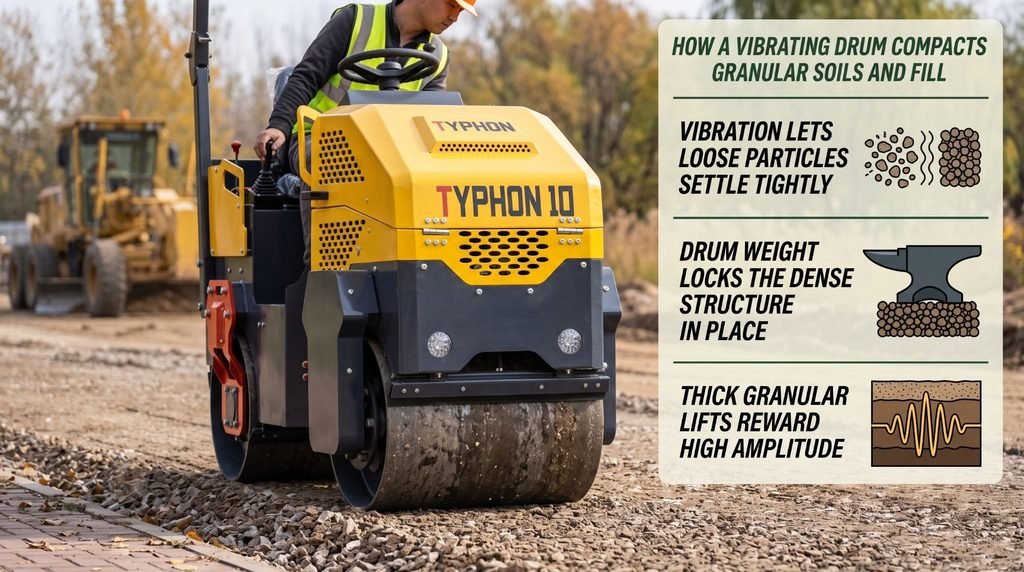
Granular materials, the sands, gravels, and crushed aggregates that make up so much structural fill, respond to vibration better than almost anything else. Their particles are loose and largely free to move, and when the drum shakes them, they lose the friction that held them in a loose arrangement and settle into a tighter, denser packing. The vibration briefly liquefies the contact between grains just enough for them to slide past one another and nest closely together, and the drum’s weight then locks that dense structure in place. This is why vibratory compaction is the method of choice for granular fill: the shaking does work that static rolling simply cannot match.
Because granular soils accept energy so readily, they reward high amplitude and the deeper reach it provides, especially on the thick lifts common in structural fill work. A drum set to drive strong force well down into the layer compacts the full depth in a sensible number of passes, stabilizing the lift from the bottom up rather than leaving a soft base beneath a firm crust. The coarser and thicker the material, the more amplitude it tends to want. Frequency still matters, but on deep granular lifts the depth of energy usually takes priority, which is why operators lean on the higher amplitude setting when packing loose fill toward target density.
Key takeaway: Granular soils compact readily under vibration because loose particles rearrange into a denser packing, so high amplitude and its deep reach suit the thick lifts typical of granular fill.
How Surface Type Determines the Right Drum Settings
Everything above points to a single principle: the material under the drum decides the correct settings, not the other way around. A vibrating drum is a versatile tool precisely because its amplitude and frequency can be tuned, but that versatility only pays off when the operator reads the surface and matches the machine to it. Thick, loose granular lifts want deep energy, so high amplitude carries the day. Thin, delicate layers and hot asphalt want gentle, rapid impacts near the surface, so low amplitude and high frequency take over. Cohesive clay wants heavy, manipulating blows and often a different drum entirely. Applying one fixed setting across all of them guarantees poor results on at least some of the work.
Lift thickness reinforces this the same way material type does. A deep lift needs the compaction energy to reach all the way down, or the bottom stays soft beneath a compacted surface, a hidden weakness that undermines the finished structure. A thin lift needs energy concentrated near the top, because deep, high-amplitude blows on a shallow layer can shake it apart or bounce the drum. Reading both the material and the lift thickness together tells the operator which amplitude and frequency the pass demands. The best compaction results come from treating the drum’s settings as a response to the surface rather than a habit carried from one job to the next, and this adaptability is exactly what makes a modern vibratory roller so capable across varied work.
Key takeaway: The material and lift thickness dictate the correct amplitude and frequency, so matching drum settings to each surface, rather than applying one fixed setting, is what delivers reliable compaction.
Practical Tips for Adjusting Vibration to Different Materials
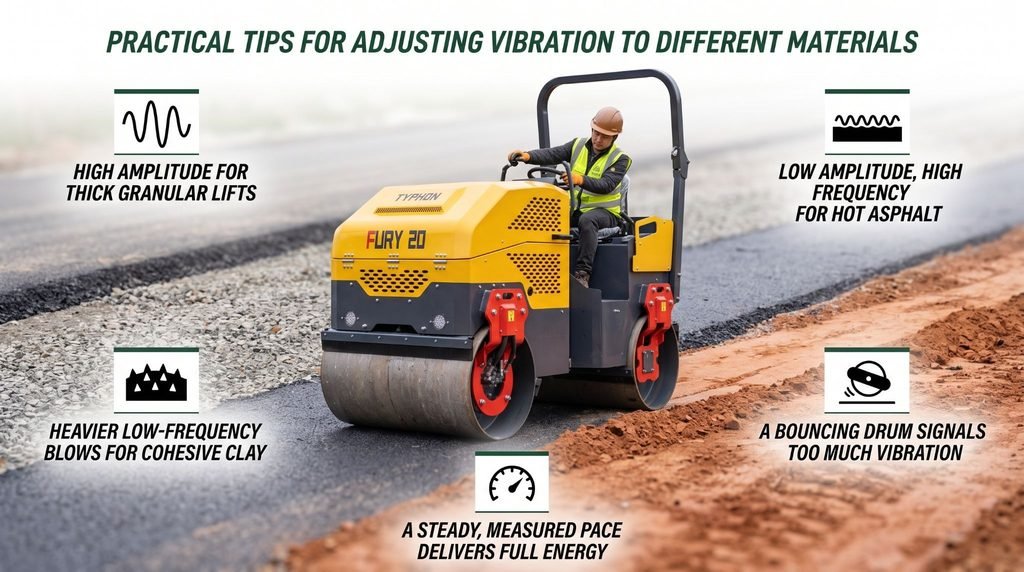
Getting the most from a vibrating drum comes down to reading each surface honestly and adjusting the machine to suit it. Start every material with the settings its nature suggests: high amplitude for thick granular lifts that need deep energy, low amplitude and high frequency for thin layers and hot asphalt that need a gentle surface touch, and heavier low-frequency blows or a padfoot drum for cohesive clay that resists ordinary vibration. Then confirm the choice by watching how the material and the drum respond over the first passes, because the surface itself gives clear feedback when the settings are right or wrong. A drum that begins to bounce, for instance, signals that the vibration is too strong for the layer, and continuing risks uneven compaction and damage to both the mat and the machine, so it calls for lower amplitude or a change of pace.
Travel speed deserves as much attention as the vibration settings, since moving too fast spreads the compaction energy thinly over more ground while crawling too slowly can over-work a surface, especially on asphalt. A steady, measured pace lets each pass deliver its full energy evenly, and a deliberate, overlapping pass pattern concentrates effort where density demands it without wasting passes on ground already compacted. Keep an eye on moisture when working soils, because even perfect drum settings cannot compact material outside its workable moisture range. Finally, switch off vibration for finishing passes when the goal is a smooth surface rather than deeper density, letting the drum’s weight alone leave a clean result. Taken together, these habits recover much of the density and efficiency that a fixed, inattentive approach quietly forfeits.
Key takeaway: Match starting settings to each material, then adjust by watching how the surface and drum respond, holding a steady speed and correct moisture while reserving static passes for finishing.
Conclusion
A road roller’s vibrating drum compacts different surfaces so effectively because its force can be shaped to suit whatever lies beneath it. The eccentric shaft generates dynamic force on top of the drum’s static weight, and the amplitude and frequency of that vibration decide how deep the energy reaches and how rapidly it strikes. Granular soils rearrange readily and reward the deep reach of high amplitude, cohesive clay resists vibration and needs heavier blows, correct moisture, and often a padfoot drum, and fragile hot asphalt calls for gentle, rapid impacts at low amplitude and high frequency. In every case the surface and lift thickness dictate the settings, and a skilled operator adjusts the machine to the material rather than forcing one approach onto all of them. Read the surface, match the vibration, hold a steady pace, and the drum delivers dense, durable compaction across the full range of materials a job demands.
Frequently Asked Questions
What is the difference between amplitude and frequency on a vibrating drum?
Amplitude is how far the drum moves during each vibration, affecting how deeply the compaction force reaches. Frequency is how many times the drum vibrates per minute, affecting how quickly the impacts occur. Use higher amplitude for deeper lifts and lower amplitude for surface work. Match frequency to the material and layer thickness.
Why does a vibrating drum work well on gravel but struggle on clay?
Gravel responds well to vibration because its loose particles can shift into a denser arrangement. Clay particles are cohesive and resist this movement, making vibration less effective. Heavy clay usually compacts better with a padfoot or sheepsfoot drum, suitable pressure, and proper moisture.
Should I always use vibration when compacting asphalt?
No. Vibration is useful during early and intermediate passes while the asphalt is hot, helping densify the mat. Excessive vibration can cause cracking or movement, especially at low travel speeds. For final finishing, operators often switch to static rolling to smooth the surface. Timing and proper vibration settings are key.